
Previous
Next
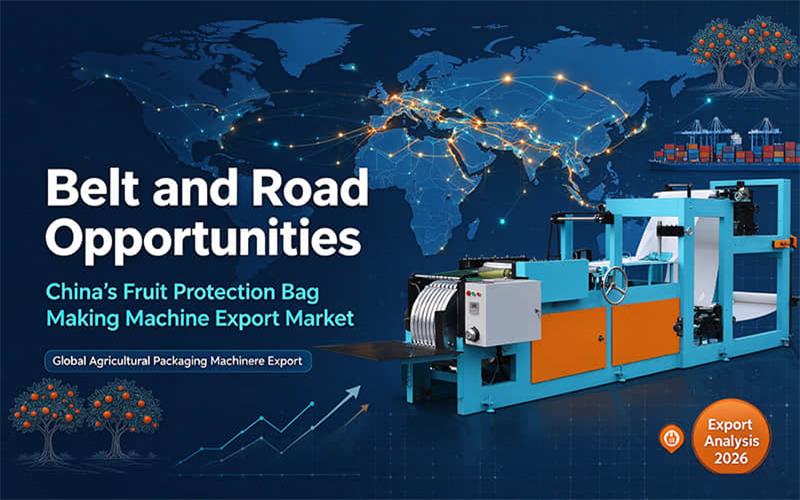
Belt and Road Opportunities: In‑Depth Analysis of China’s Fruit Protection Bag Making Machine Export
Description
Fruit bagging technology has rapidly spread across emerging agricultural economies. Fruit protection bags shield apples, mangoes, citrus, pears and peaches against sunburn, hail, pests and pesticide residues, improving fruit appearance and satisfying international export certification standards.
As Belt and Road cooperation deepens, Chinese‑manufactured fruit protection bag making machine has become one of the competitive agricultural packaging machinery exports. More fruit bag factories, orchard groups and machinery importers from Belt‑and‑Road‑participating countries are sourcing automatic and semi‑automatic fruit growing cover bag machines directly from Chinese manufacturers.
This article delivers an in‑depth market analysis covering core competitive advantages of Chinese fruit bag machines, high‑potential target regions, major export obstacles, market trends and practical recommendations for global buyers and machinery suppliers.
Overview of China’s Fruit Bag Machine Export under Belt and Road Initiative
China is the world’s primary manufacturing base for fruit protection bag making equipment. Domestic factories produce full‑series machines including single‑layer, double‑layer, paper waterproof and biodegradable non‑woven fruit bag production lines.
Thanks to cross‑border trade facilitation, improved logistics links and rising demand for high‑quality fresh fruits, Belt‑and‑Road economies represent the fastest‑growing overseas market for Chinese fruit bag making machines.
Key market highlights:
Large‑scale tropical and temperate fruit plantations push local demand for domestic fruit bag production capacity
Many importing countries are shifting from purchasing finished fruit bags to importing bag‑making machinery
Semi‑automatic compact models are popular for small‑and‑medium investors; high‑speed fully‑automatic lines serve large‑scale industrial bag plants
RCEP and Belt‑and‑Road trade frameworks reduce trade barriers for agricultural machinery tradeAlibaba Se...
Core Competitive Advantages of Chinese Fruit Protection Bag Making Machines
Cost‑performance Edge for Global Agricultural Buyers
Compared with European and Japanese equivalent equipment, Chinese fruit growing cover bag machine delivers solid performance at a more reasonable investment threshold. Both semi‑automatic entry‑level units and high‑speed full‑automatic production lines are available to match different project budgets for importers, startup bag factories and large orchard enterprises.
Rich Customization Capacity for Diverse Fruit Varieties
Chinese manufacturers can adjust machine structures to produce apple bags, mango bags, citrus bags, grape bags and avocado protective sleeves. Supported functions include hole‑punching, waterproof coating, surface printing and size adjustment. This flexibility fits diversified fruit‑planting conditions across Belt‑and‑Road nations.
Mature Complete‑Set Supporting Technology
Many suppliers offer complete solutions: machine commissioning guidance, paper‑material matching suggestions, operation manuals and video tutorials for overseas end‑users.
Continuous Machinery Technology Upgrades
New‑generation China‑built fruit bag making machines adopt PLC touch‑screen control, automatic fault alarm and remote diagnosis functions. Energy‑saving improvement and multi‑material compatibility keep enhancing product competitiveness in international markets.
High‑Potential Belt‑and‑Road Regional Import Markets
Key drivers for fruit bagging machine exports include the steadily rising global demand for standardized fruit production; fruit bagging is being adopted in an increasing number of developing countries as a crucial measure to enhance the visual quality of fruit and reduce pesticide residues.
Southeast Asia (Top Growth Market)
Southeast Asia stands out as the biggest importer of Chinese fruit protection bag making machine. Major target countries include Thailand, Vietnam, Indonesia, Philippines and Malaysia.
Large‑scale mango, durian, citrus and longan plantations are expanding. Fruit exporters need qualified protective bags to meet global food‑safety standards. Many local entrepreneurs build domestic fruit‑bag manufacturing workshops instead of importing expensive finished bags. Compact semi‑automatic machines are widely favored by small‑and‑medium enterprises in this region.
Latin America
Latin America is the fast‑rising emerging market under Belt and Road framework. Mexico, Brazil, Peru and Chile own massive avocado, mango and citrus orchards.
Local agricultural businesses gradually recognize the benefits of fruit bagging technology. Demand concentrates on mid‑speed automatic fruit growing cover bag machines. Buyers pay high attention to machine stability and adaptability to locally‑sourced paper raw materials.
Central Asia & Russia
Countries such as Uzbekistan, Kazakhstan and Russia develop apple, pear and stone‑fruit planting industries. Harsh sunlight, hail and cold weather create strong requirements for fruit protective bags.
Most buyers prefer double‑layer fruit‑bag production machines. Due to long transportation distances, spare‑parts supply and after‑sales support become key considerations during purchasing decisions.
Middle East & North Africa
Commercial citrus and pomegranate orchards keep expanding across Middle‑East and North‑African territories. Intense solar radiation causes serious fruit sunburn problems. At present, most orchards import pre‑made fruit bags. Local bag‑making factory construction projects are expected to increase in the coming years, bringing future opportunities for Chinese fruit bag paper machine suppliers.
Regionally, Asia-Pacific remains the world's largest hub for the production and consumption of fruit bags; the region is projected to hold a 47.6% global market share by 2026, with a market size of $3.92 billion, driven by China, India, and Japan, which collectively account for over 70% of regional demand. Southeast Asia and South Asia are expected to emerge as the next major growth hotspots due to the continued expansion of their fruit industries.
Conclusion
The Belt and Road Initiative unlocks huge export potential for China‑built fruit protection bag making machines. Driven by booming premium fruit export businesses across Southeast Asia, Latin America, Central Asia and Middle East, demand for fruit growing cover bag machinery maintains positive momentum.Southeast Asia and South Asia are poised to become the next major growth hotspots, fueled by the continued expansion of their fruit industries.
FAQ: Frequently Asked Questions for Belt‑and‑Road Fruit Bag Machine Import
Q1: Which Belt‑and‑Road countries import most Chinese fruit protection bag making machines?
Southeast‑Asian nations including Thailand, Vietnam and Indonesia are the top importers. Latin America represents the fastest‑growing market, followed by Central Asia and Middle‑East countries with expanding commercial fruit orchards.
Q2: What machine types are most popular for Belt‑and‑Road market buyers?
Semi‑automatic compact fruit bag making machines are widely chosen by small‑and‑medium startup factories. Large industrial fruit‑bag manufacturers prefer high‑speed fully‑automatic lines supporting Insert the wire, printing and adjustable bag size.
Q3: What should importers check before placing fruit‑bag‑machine orders from China?
Confirm target bag sizes, raw‑material parameters, required hourly output, local voltage standard, certification requirements, after‑sales policy and spare‑parts supply terms before finalizing purchase contracts.