
Previous
Next
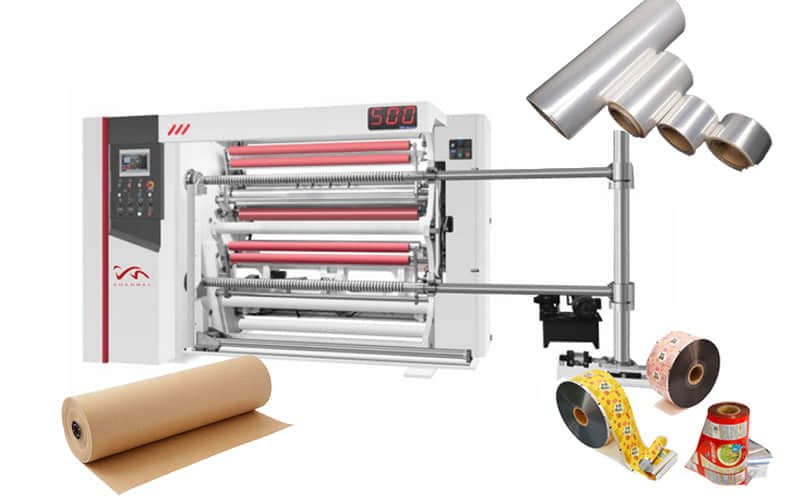
GS-C1300 High Speed Slitting and Rewinding Machine | Precision Converting Solution
- Shaftless hydraulic loading and unloading
- Can be 3 "6" air expansion shaft
- Photoelectric or ultrasonic tracking
- Straight knife or Disc knife
- Optional auxiliary row of knives, automatic row of knives
- Opitional automatic waste rewinder
Description
Industrial Converting Equipment · CE Certified
GS-C1300 High-Speed
Slitting & Rewinding Machine
Convert jumbo rolls to precision-slit finished rolls at 350 m/min — dual-mode blade (shear + razor), closed-loop servo tension, CCD edge tracking, and shaftless hydraulic unwind. One machine for the full substrate range.
500 m/min
Max Slitting Speed
±0.1 mm
Edge Accuracy
1300 mm
Max Material Width
1500 kg
Max Roll Load
Machine Architecture
System Overview: Five-Station Web Path
A full-width jumbo roll is unwound under closed-loop tension, slit to width by rotary shear or razor blades, edge-corrected by CCD camera, and rewound into finished rolls — in a single continuous pass.
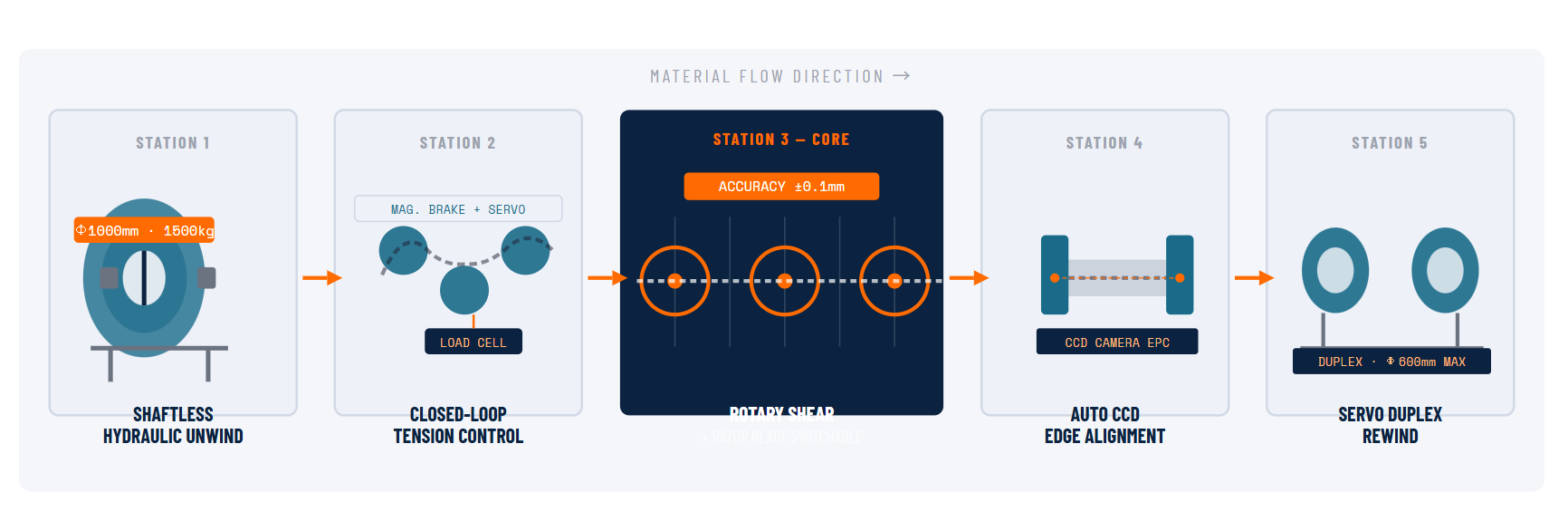 GS-C1300 web path: hydraulic shaftless unwind → closed-loop servo tension control → dual-mode slitting → CCD edge alignment → duplex servo rewind
Technical Specifications
GS-C1300 Full Specification Sheet
Complete parameters for engineering evaluation, production line integration, and supplier comparison. All values are guaranteed under standard operating conditions (18–28°C, stable-quality substrate).
| Parameter | Specification | Engineering Notes |
|---|---|---|
| MAX MATERIAL WIDTH | 1300 mm | Centering spacers accommodate 1000mm and 1100mm rolls on the same machine without tooling change. |
| MAX SLITTING SPEED | 0 – 350 m/min | Full speed for slit widths ≥300mm on stable substrate. Narrow cuts (20–80mm): optimal 150–200 m/min for tension consistency across lanes. |
| SLITTING ACCURACY | ±0.1 mm | Servo blade-carriage positioning + CCD EPC feedback. Verified across the full operating speed range on BOPP and PET. |
| MIN SLITTING WIDTH | 20 mm (razor mode) 30 mm (shear mode) | Razor score-cut method enables narrower cuts on thin films. Shear limited to 30mm for blade-clearance and inter-roll spacing. |
| MAX UNWIND DIAMETER | Φ 1000 mm Φ 1200 mm optional | Hydraulic shaftless loading arm; pneumatic chuck locking. No manual shaft threading. Changeover <90 seconds. |
| MAX REWIND DIAMETER | Φ 600 mm | Duplex rewind stations A+B; surface and center winding selectable. Pneumatic differential air shafts standard. |
| MAX ROLL WEIGHT | 1500 kg | Standard BOPP/PE jumbo rolls: 400–900kg. Paper jumbo rolls: up to 1500kg. Hydraulic arm rated to full 1500kg. |
| BLADE SYSTEM | Rotary shear + razor blade (dual, switchable) | Switch between shear and razor in <4 min without specialized tools. Shear for paper/board (30–350gsm); razor for film (10–150μm). |
| MATERIAL THICKNESS | Film: 10–150 μm Paper: 30–350 gsm | Extended range for optical film (5μm+) available with optional tension modification kit. |
| TENSION CONTROL | Closed-loop servo + load cell | Unwind: magnetic powder brake + load cell feedback. Rewind: servo + programmable taper tension curve. Accuracy ±1% of set value. |
| EDGE ALIGNMENT | CCD camera EPC | ±0.2mm tracking accuracy. Works on transparent, opaque, holographic, and metalized webs. Standard ultrasonic sensors fail on clear film below 15μm. |
| CONTROL SYSTEM | Siemens S7 PLC + 10″ HMI | 100 product recipe storage. Data logging, alarm history, Ethernet/IP for MES/ERP integration. OPC-UA optional. |
| TRIM EDGE REMOVAL | Auto suction + pneumatic routing | High-power inline fan continuously removes trim during operation. Handles trim widths down to 5mm without operator intervention. |
| CORE SIZES | 3″ (76mm) / 6″ (152mm) | Pneumatic differential air shafts; adjustable for multi-slit duplex unloading configurations. |
| POWER SUPPLY | 3-phase 380V / 50Hz | 50Hz/60Hz variants available. Total installed power ≈22 kW. 60Hz/480V for North America on request. |
| MACHINE FOOTPRINT | ≈ 6.8 × 2.2 × 2.0 m | Includes full unloading clearance zone. Compact-floor variant available for constrained installations. |
| CERTIFICATION | CE · ISO 9001 | Full CE documentation for EU import. Machine guarding per EN 13849-1 Performance Level d (PLd). ISO 9001 manufacturing process. |
Application note: Maximum rated speed is measured on stable-quality BOPP film, slit width ≥300mm, ambient 18–28°C. Real-world production speed depends on material consistency, slit count, and operator skill. Xuanhai's application engineers provide a site-specific speed and tension recommendation before order confirmation — at no charge.
Compatible Materials
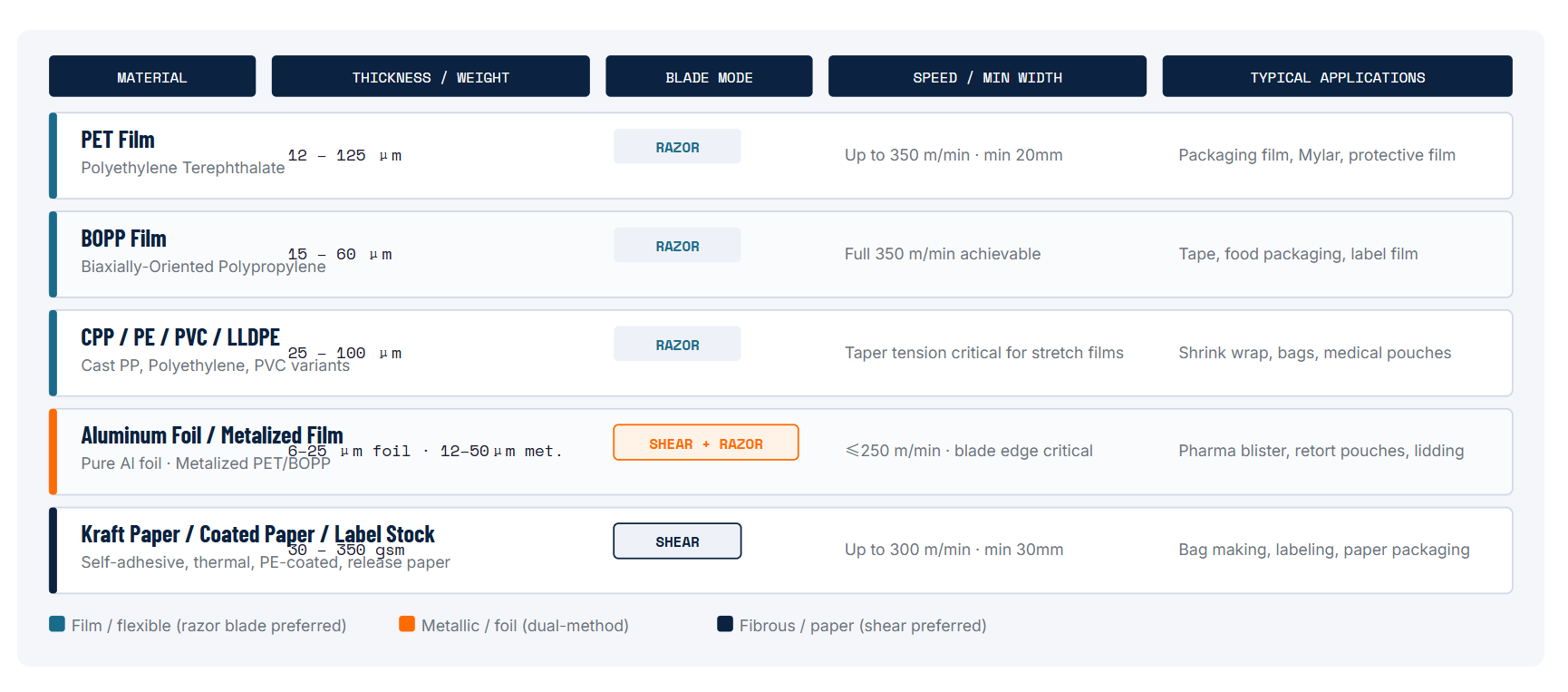
Substrate Range: Film, Foil & Paper in One Machine
The GS-C1300's dual-mode blade design covers the full flexible packaging substrate range without reconfiguration — from 10μm optical film to 350gsm kraft paper.
 Engineering Differentiators
Six Decisions That Separate the GS-C1300 from Standard Market Slitters
These are not checkbox features. Each represents a deliberate engineering choice that solves a specific production problem operators encounter daily on standard-spec 1300mm slitters.
Dual-Mode Slitting — One Machine, Full Substrate Range
Most 1300mm slitters are factory-configured for one blade type. Changing blade mode requires a service call or hours of downtime. The GS-C1300 carries both rotary shear and razor blade stations — operators switch modes in under 4 minutes without special tools. A single machine handles 10μm PET film through 350gsm kraft board.
Programmable Multi-Point Taper Tension Curve
Industry-standard machines implement taper tension as a fixed percentage drop from core to full roll — a blunt approximation. The GS-C1300 runs a multi-point programmable spline: define tension versus roll diameter at any number of set points. This eliminates core crushing at start and telescoping at large diameters, critical for soft laminates, LLDPE, and stretch film.
Shaftless Hydraulic Unwind — <90-Second Roll Changeover
Conventional slitters require threading an unwind shaft (50–80kg) through the jumbo roll core — 3–8 minutes per roll. The GS-C1300's hydraulic shaftless arm positions and locks the roll with pneumatic chucks in under 90 seconds. On a shift running 4–6 roll changes, this recovers 15–40 minutes of productive machine time.
CCD Camera EPC — Not Ultrasonic
Ultrasonic edge sensors — standard across nearly all competing 1300mm-class slitters — fail on transparent and ultra-thin films below 15μm, where the acoustic signal passes through without sufficient reflection. The GS-C1300's CCD camera EPC uses optical contrast-edge detection: it tracks clear, translucent, holographic, and metalized webs with equal ±0.2mm accuracy across the full speed range.
100-Recipe Siemens PLC with MES Integration
Product changeover is instant: select the saved recipe for a job and the machine reconfigures blade positions, tension curves, and speed ramps automatically. The Siemens S7 PLC transmits live production data — speed, meters, tension, alarms — via Ethernet/IP to your MES or ERP platform, enabling real-time OEE tracking without manual logbooks.
Inline Auto Trim Suction — Continuous, Not Batch-Emptied
Many slitters manage trim edges with a catch basket that operators must empty mid-run — creating a stop or a safety compromise. The GS-C1300's high-power suction fan removes trim continuously at line speed, routing it pneumatically to a remote bin. Handles trims down to 5mm wide without operator attention, even during narrow multi-lane slitting at full speed.
Competitive Comparison
GS-C1300 vs Standard 1300mm-Class Slitter Rewinders
How the GS-C1300 stacks up against published specifications of mainstream 1300mm slitter rewinders from the Chinese and Taiwanese converting equipment market.
| Feature / Capability | GS-C1300 Xuanhai Machine | Standard Market 1300mm Class |
|---|---|---|
| Max slitting speed | 500 m/min | 200–300 m/min |
| Dual blade mode (shear + razor) | ✓ Standard, switch <4 min | △ Single mode typical |
| Slitting accuracy | ±0.1 mm | ±0.2–0.5 mm |
| Min slit width | 20 mm (razor) | 30–50 mm typical |
| Edge position control | ✓ CCD camera EPC | △ Ultrasonic (fails <15μm clear film) |
| Shaftless hydraulic unwind | ✓ Standard | ✗ Extra cost or unavailable |
| Programmable taper tension curve | ✓ Multi-point spline | △ Fixed ratio only |
| Recipe storage | 100 recipes | 10–30 typical |
| MES / ERP integration | ✓ Ethernet/IP standard | ✗ Not standard |
| Auto trim suction (inline) | ✓ Continuous fan | △ Manual basket common |
| CE certification | ✓ Full documentation | △ Varies by supplier |
| After-sales parts | Siemens + standard components | Proprietary — varies |
✓ Standard · △ Optional or partial · ✗ Not available. Competitor data based on published specifications from major Chinese and Taiwanese 1300mm-class slitter rewinder manufacturers as of 2024–2025.
Production Economics
What 500 m/min Means for Shift Output
Speed on a datasheet only matters if it translates into throughput and unit economics. Below is a realistic shift-output comparison accounting for roll changeover time and operating efficiency.
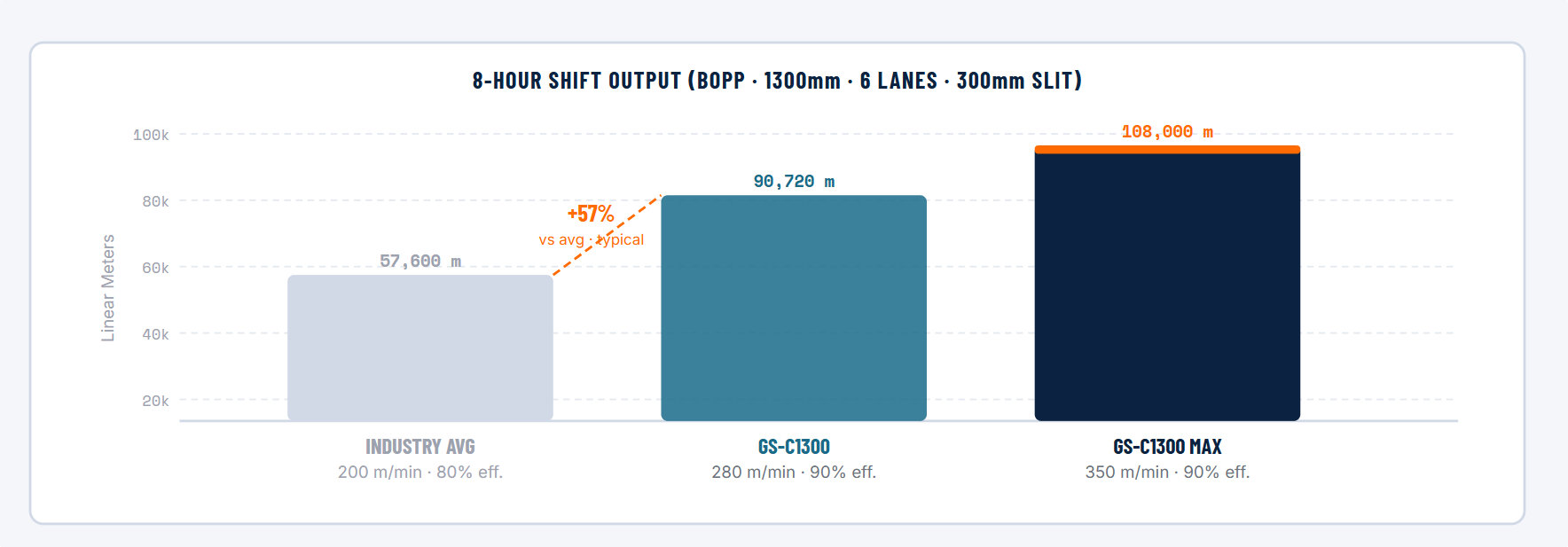 Calculation basis: 8-hour shift, BOPP 1300mm, 6 lanes at 300mm slit width. Efficiency accounts for roll changeover (<90 s on GS-C1300 vs 5+ min on shaft-type machines), speed ramp time, and minor stops. At typical converting margins of $0.004–0.008 USD/linear meter, the +57% throughput differential represents meaningful reduction in per-unit converting cost over 250+ annual operating days.
Operation Guide
Setup-to-Production in 6 Steps
A trained operator on the GS-C1300 completes a full roll changeover and new-job setup in under 15 minutes. Here is the standard operating sequence — documented for training and process reference.
01
Load the Jumbo Roll
Use the hydraulic shaftless loading arm to position the jumbo roll on the unwind stand. Align to machine centerline via the laser guide. Lock pneumatic chucks. No shaft threading required — total load time: under 90 seconds, including roll positioning and alignment.
02
Thread the Web
Pull the leading edge through the S-wrap tension rollers, past the CCD EPC sensor, and through the open blade carriage to the rewind shafts. Attach to rewind cores using the pneumatic chuck system. Enable trim suction before blade engagement.
03
Load or Create a Product Recipe
On the 10-inch HMI, select from up to 100 stored product recipes — or enter parameters: slit widths, target roll diameter, taper tension curve, and speed ramp profile. Blade carriages servo-move to programmed positions automatically upon recipe confirmation.
04
Verify Blade Position and Mode
Confirm blade positions against the HMI digital readout. For shear mode: set upper/lower blade overlap at 0.1–0.5mm per substrate thickness. For razor mode: confirm score depth and cooling air pressure. Blade condition indicator alerts before quality impact.
05
Crawl Speed Verification, Then Ramp to Production Speed
Start at 10–20 m/min. Verify edge alignment, roll formation on each lane, and tension readout stability. CCD EPC actively tracks and corrects position. Once all lanes confirmed stable, engage automatic speed ramp. The machine accelerates in a controlled profile to target speed.
06
Auto-Stop and Unload Finished Rolls
Machine stops automatically at preset meter count or rewind diameter limit. Use the pneumatic unloading device to discharge finished rolls to the outfeed conveyor. Log the run — or have it auto-reported to MES via Ethernet/IP. The machine is ready for the next core set immediately.
Frequently Asked Questions
Technical Questions — Answered Directly
Written for operations engineers and procurement teams evaluating slitter rewinders — not for a brochure. If your question is not here, contact our application engineering team.
- What is the actual maximum slitting speed of the GS-C1300 in production?The rated maximum is 500 m/min. In production, three variables constrain achievable speed: (1) slit width — cuts narrower than 100mm should be run at 200–500 m/min to maintain inter-lane tension uniformity; (2) substrate quality — base material with tension bars, gel particles, or edge damage triggers instability at high speed; (3) roll diameter — at near-maximum rewind diameters, inertia requires taper tension compensation that slightly limits peak speed. For 300mm-and-wider cuts on quality BOPP or PET, 320–350 m/min is routinely achieved in production.
- What is the difference between rotary shear and razor blade slitting, and which mode does the GS-C1300 use?The GS-C1300 uses both — switchable without tools in under 4 minutes. Rotary shear (circular upper blade crossing a lower blade ring) shear-cuts the web: clean, burr-free, ideal for paper (30–350gsm), board, self-adhesive, and thick laminates. Razor blade (score-cut with a stationary razor against a hardened groove) is preferred for thin flexible films (PET, BOPP, CPP, PE at 10–150μm) where score-cutting produces a clean, particle-free edge. Most competing 1300mm slitters ship configured for one mode. The GS-C1300 eliminates that constraint.
- Why does the GS-C1300 use CCD edge position control instead of ultrasonic sensors?Ultrasonic EPC transmits a sound pulse through the web and measures reflected energy. On transparent or ultra-thin films — clear PET, OPP below 15μm — the signal passes through without sufficient reflection, causing the sensor to lose track, hunt, or generate false corrections. This is a documented limitation of ultrasonic EPC across all manufacturers. The GS-C1300's CCD camera system uses optical contrast-edge detection: it identifies the web edge regardless of optical transparency, material thickness, or surface treatment. Tracking accuracy is ±0.2mm on clear, metalized, holographic, and opaque webs alike.
- Can the GS-C1300 be integrated with a factory MES or ERP system?Yes. The Siemens S7 PLC includes Ethernet/IP connectivity as standard. The machine transmits live production data — current speed, meters produced per station, tension readings, alarm codes, operator ID — to any MES or ERP system capable of receiving Ethernet/IP or Modbus TCP/IP data. OPC-UA is available as an option for broader compatibility. This eliminates manual production logbooks and enables real-time OEE calculation at machine level. Contact Xuanhai's engineering team with your MES platform requirements for compatibility confirmation.
- What is the minimum slit width, and when does it matter?In razor blade mode on thin film: 20mm minimum. In rotary shear mode: 30mm minimum, limited by blade clearance and the physical spacing needed between adjacent rewind rolls. For slitting below 20mm — industrial tape at 10–18mm widths, for example — a surface-rewind narrow slitter is the appropriate machine class. The GS-C1300 is optimized for 20mm–1300mm output widths where multi-lane productivity and tension control are the primary variables.
- What certifications does the GS-C1300 carry, and is it suitable for CE-required import markets?The GS-C1300 carries CE marking under the EU Machinery Directive 2006/42/EC, with machine guarding designed to EN 13849-1 Performance Level d (PLd). Full CE technical documentation — Declaration of Conformity, risk assessment, electrical schematics in English and German — is provided for EU customs clearance. The manufacturing process is certified under ISO 9001. For North American requirements (OSHA, ANSI, CSA), or other regional safety standards, please consult Xuanhai's export engineering team for specific compliance documentation.
- How quickly can a jumbo roll be changed on the GS-C1300 compared to a conventional slitter?Roll changeover on the GS-C1300 averages under 90 seconds using the hydraulic shaftless unwind arm. Conventional shaft-type slitters require the operator to thread a 50–80kg shaft through the core, lift the loaded shaft into the unwind cradle, and tighten locking nuts — typically 3–8 minutes per changeover. On a high-volume shift running 4–6 roll changes, the GS-C1300's shaftless loading recovers 15–40 minutes of productive time — equivalent to 5–8% improvement in machine utilization on roll-limited operations.
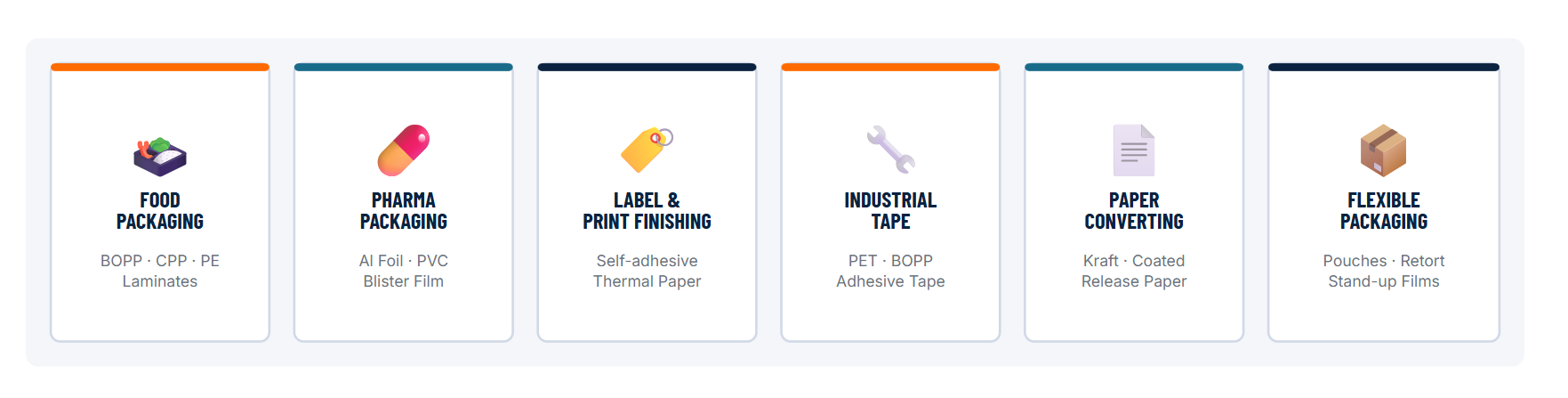
Industry Applications
Where GS-C1300 Converts Roll Material
The GS-C1300 functions as the precision finishing stage between jumbo roll production (paper mill, film extruder, laminator) and end-use packaging or print manufacturing. Six primary deployment sectors:
 Complete Your Production Line
Upstream & Downstream Equipment from Xuanhai
The GS-C1300 integrates directly with Xuanhai's full converting equipment range for a single-source, technically consistent production line from raw film to finished bag.
Flexographic Printing Machine Laminating Machine Stand-Up Pouch Making Machine 3-Side Seal Bag Making Machine Spout Pouch Machine Web Inspection System Label Slitting Machine Shrink Sleeve Making Machine Center Seal Bag Machine
All equipment manufactured at Ruian Xuanhai Machine Co., Ltd. in Ruian, Zhejiang, China. Combined-order shipping, unified technical documentation (CE, manuals, spare-parts lists), and single-contact after-sales support available for complete line orders.
Get the GS-C1300 Specification & Price
Our application engineers respond within 1 business day with a formal quotation, site-specific speed and tension recommendation, and lead time.
Request Formal Quotation Contact Engineering TeamGS-C1300 · High-Speed Slitting & Rewinding Machine · Ruian Xuanhai Machine Co., Ltd. · pouchesmachine.com CE · ISO 9001 · Export to 60+ Countries