
Previous
Next
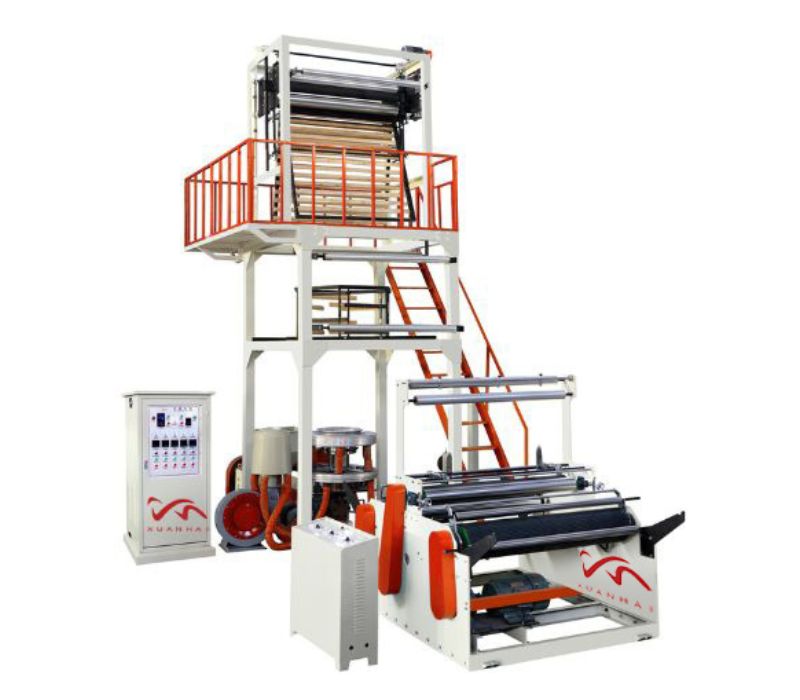
What Is a Rotary Die Head PE Film Blowing Machine? — Specs, Price & Applications
- With Rotary Head
- Double rewinder
- Film width from 100-3000mm
Description
In Stock & CE Certified
Rotary Head
PE Film Blowing
Machine
360° rotating die head technology for HDPE, LDPE & LLDPE — producing flawless uniform film from 600 mm to 2000 mm wide, at outputs up to 90 kg/h.
360° Rotary Die Head
90 kg/h Max Output
2000 mm Max Film Width
CE Certified
Engineering Insight
Why the Rotating Die Head
Changes Everything
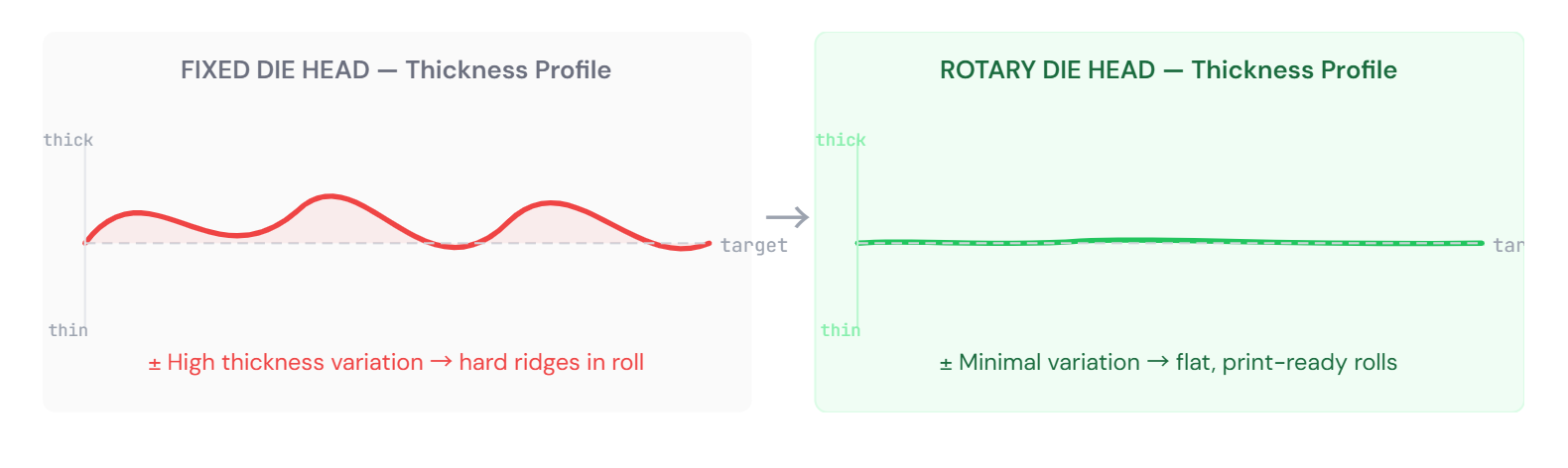
Most blown film machines use a fixed die head. The rotary die head solves a fundamental physics problem: extruder output is never perfectly uniform at every angular position. In a fixed die system, this variation accumulates in the same spot of every roll — creating hard ridges, poor winding, and rejection at printing or lamination. The 360° rotating die head continuously redistributes this variation, averaging it across the entire roll width.
Fixed Die Head Standard
Thickness variation accumulates at fixed angular positions
Creates hard ridges that cause roll misalignment
Reduced suitability for printing and lamination downstream
Higher edge trimming waste on wide film formats
Rotary Die Head This Machine
Thickness variation averaged evenly across the entire roll
Tight, uniform winding with no hard lines in the roll
Print-ready film with excellent lay-flat performance
Lower material waste, higher downstream yield
Film Thickness Profile: Fixed vs. Rotary Die Head
 Technical Data
Machine Specifications
Standard model range covers SJ-B50 through SJ-B75. Custom configurations available on request for wider film formats or specialty materials.
LDPE HDPE LLDPE
| Parameter | SJ-B50 Model | SJ-B65 Model | SJ-B75 Model |
|---|---|---|---|
| Screw Diameter | 50 mm | 65 mm | 75 mm |
| L/D Ratio | 28:1 | 28:1 | 30:1 |
| Max Layflat Width | 600 mm | 1200 mm | 2000 mm |
| Film Thickness Range | 0.008–0.10 mm | 0.008–0.12 mm | 0.010–0.15 mm |
| Max Output | 35 kg/h | 60 kg/h | 90 kg/h |
| Die Head Type | 360° Rotary | 360° Rotary | 360° Rotary |
| Screw & Barrel Material | 38CrMoAl (Nitrided) | 38CrMoAl (Nitrided) | 38CrMoAl (Nitrided) |
| Motor Control | VFD (Inverter) | VFD (Inverter) | VFD (Inverter) |
| Rewinder | Double Rewinder | Double Rewinder | Double Rewinder |
| Heating Zones | 3 zones | 4 zones | 5 zones |
| Certification | CE | CE | CE |
CE Certified Machinery
1-Year Machine Warranty
On-site Installation Available
Factory Direct Pricing
Engineering Details
Built for Industrial
Production Demands
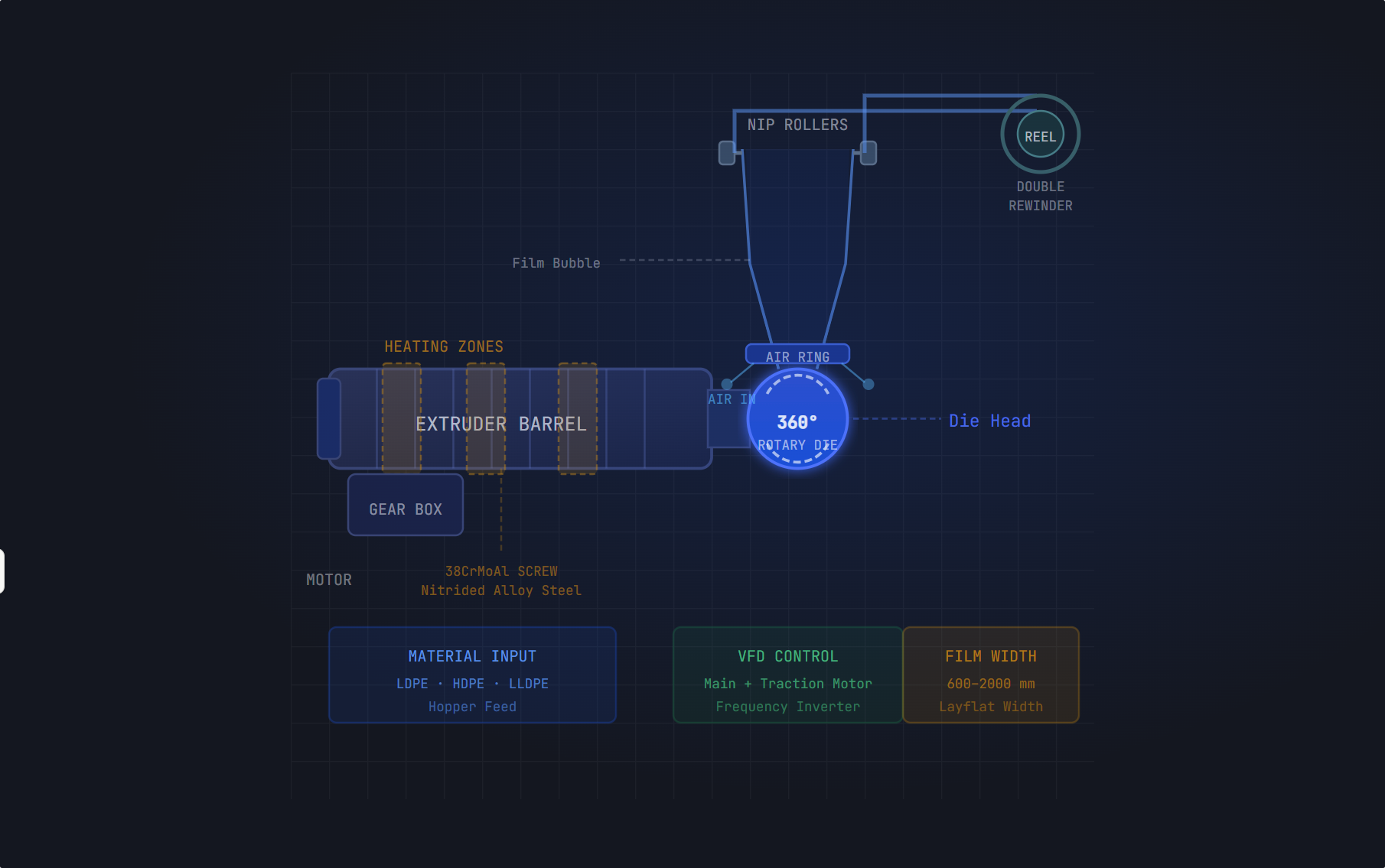
38CrMoAl Nitrided Screw & Barrel
High-alloy chromium-molybdenum-aluminum steel, hardened via nitrogen treatment to achieve surface hardness exceeding HRC 65. Superior wear and corrosion resistance ensures 8–12 years of service life under continuous production.
360° Continuous Rotation
The die head rotates at controlled speed during film blowing, continuously redistributing any die-lip imperfections across the entire roll circumference. This is the single most impactful feature for producing tight, hard-spot-free rolls.
VFD Frequency Inverter Control
Variable-frequency drives on both main extruder and traction motors enable precise speed matching, eliminate mechanical stress at startup, and reduce energy consumption by up to 30% versus direct-on-line motor starting.
Hard-Face Precision Gearbox
Alloy-piston casting with precision-ground hard-tooth gear surfaces. Delivers smooth, low-noise torque transmission even at high extrusion loads, and maintains accuracy over long continuous production runs.
Double Rewinder System
Torque-motor-driven twin rewinders maintain even tension across the full film width and enable roll changes without stopping production. Each winder operates independently with adjustable tension for different film gauges.
Bubble Stabilizing Air Ring
Precision-engineered air ring with adjustable lip gap ensures uniform cooling airflow around the bubble circumference. Combined with a bubble stabilizing frame, this maintains consistent frost-line height critical for thickness control.
Process Flow
How a Rotary Die Head
Film Blowing Line Works
From raw PE pellets to finished film roll — understanding each stage helps you optimize output quality and minimize downtime.
1
Raw PE Pellets loaded into Hopper
2
Screw conveys & melts resin in Barrel
3
Melt enters Rotating Die Head
4
Air injected — Bubble inflates upward
5
Air Ring cools & stabilizes Bubble
6
Nip Rollers collapse Film flat
7
Double Rewinder winds finished Film Roll
Markets Served
Industries & Applications
PE film produced by this machine meets requirements across food-contact, industrial, agricultural, and retail packaging markets — often with the same machine and simple die adjustment.
T-shirt & Vest Carry Bags
Food & Frozen Packaging
Agricultural Mulch Film
Garment & Textile Bags
Industrial Heavy-duty Bags
Garbage Bag on Roll
Lamination Base Film
Building & Construction Wrap
Buyer Guidance
Frequently Asked Questions
What is the key advantage of a rotary die head over a fixed die head in blown film production?
A fixed die head produces thickness variation that repeatedly lands on the same angular position of the film roll, creating hard ridges (sometimes called "gauge bands"). These make rolls difficult to wind tightly and cause problems in downstream printing or lamination. A 360° rotary die head continuously rotates so any thickness variation is spread evenly across the entire roll, producing a far more uniform product. This is essential for high-specification packaging film destined for printing or lamination lines.
Which raw materials can this machine process?
The standard configuration processes LDPE (Low Density Polyethylene), HDPE (High Density Polyethylene), and LLDPE (Linear Low Density Polyethylene). The screw and die head geometry are optimized for polyethylene resins. For LLDPE, a longer L/D ratio screw (30:1 or higher) is recommended to ensure complete homogenization. Processing other resins such as PP or biodegradable PLA requires a different screw profile and die head configuration — please consult our engineering team for those applications.
What film thickness range can this machine produce?
Depending on model, film thickness ranges from 0.008 mm (8 microns) up to 0.15 mm (150 microns). Thinner gauges (under 0.015 mm) require stable bubble conditions and are best suited to the LDPE/LLDPE material combination. Film for lamination is commonly produced at 0.020–0.050 mm, while heavy-duty industrial bags typically run 0.060–0.120 mm.
What does the VFD (frequency inverter) control system do?
Variable-frequency drives control the rotation speed of both the main extruder motor and the traction (haul-off) motor. This allows precise, stepless adjustment of output rate and draw ratio independently. VFD control also enables soft-start ramp-up, eliminating mechanical shock at startup, and reduces peak power draw by up to 30% compared to direct-on-line motor starting. The result is longer mechanical service life, lower electricity bills, and finer control over film properties.
Can on-site installation and operator training be arranged?
Yes. Our engineering team can arrange on-site installation and operator training at your facility. This covers machine commissioning, screw and die head setup, process parameter guidance, and basic maintenance procedures. Travel, accommodation, and engineering fee apply — please contact us for a quotation based on your location and scope of work required.
How does the double rewinder work and why is it important?
The double rewinder features two independent winding stations, each driven by a torque motor that maintains consistent web tension regardless of roll diameter. When one roll reaches its set length or diameter, the operator can switch to the second station while the finished roll is changed — minimizing production stoppages. Torque-motor winding (as opposed to friction winding) is critical for producing tight, telescoping-free rolls across a wide range of film widths and gauges.
Ready to Specify Your Film Blowing Line?
Tell us your film width, material, thickness, and target output — we'll recommend the right model and provide a detailed quotation within 24 hours.