
Previous
Next
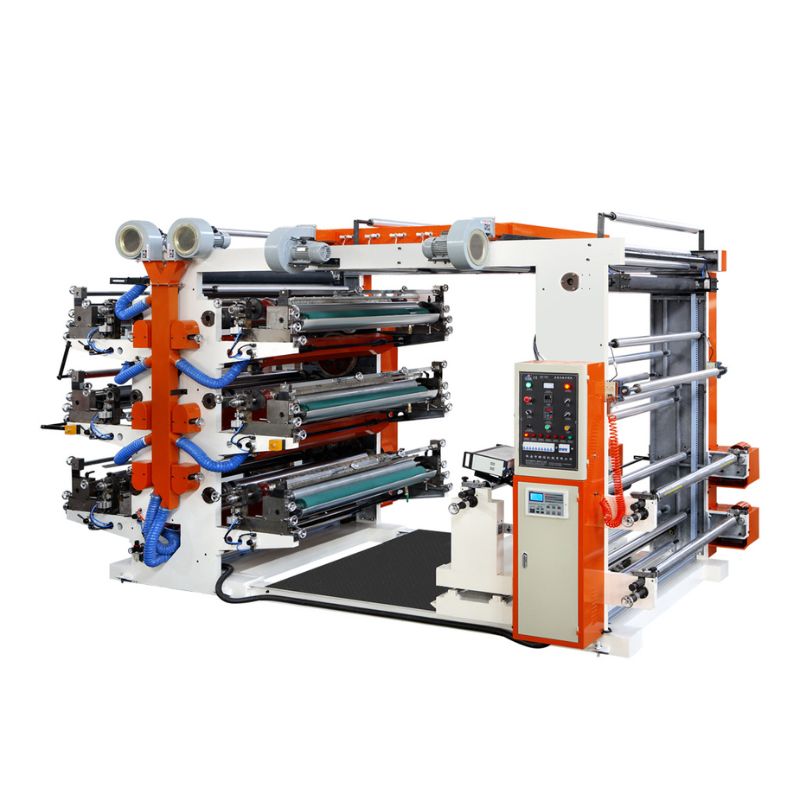
Six Color Flexo Printing Machine YT Series for HDPE LDPE Paper | YT-6600/6800/61000
- Can print 1-6 colors design
- Can do positive and negative double sides printing
- Opitional:EPC,automatic tension control
- Can be made single unwinder and rewinder
Description
Industrial Flexographic Press · Stack Type · Factory Direct
Six Color Flexo Printing Machine
for Plastic Bags & Flexible Packaging
Stack-type 6-color flexographic press engineered for PE, PP, OPP film — delivering ±0.1 mm registration precision at 80–150 m/min, with full servo tension control across every print station.
Stack-Type Architecture 6-Color CMYK + Spot Water & Solvent Ink Servo Tension Control ±0.1mm Registration CE Certified
6
Print Colors
150m/min
Max Print Speed
±0.1mm
Registration Accuracy
7+
Substrate Types
1yr
Machine Warranty
See It in Operation
Watch the six-color flexo printing machine running at full speed — stack unit engagement, anilox ink transfer, and automatic register correction in real time.
Six-color stack-type flexographic printing machine in continuous production — PE film substrate, solvent-based ink, 100 m/min operating speed.
How the 6-Color Stack Press Works
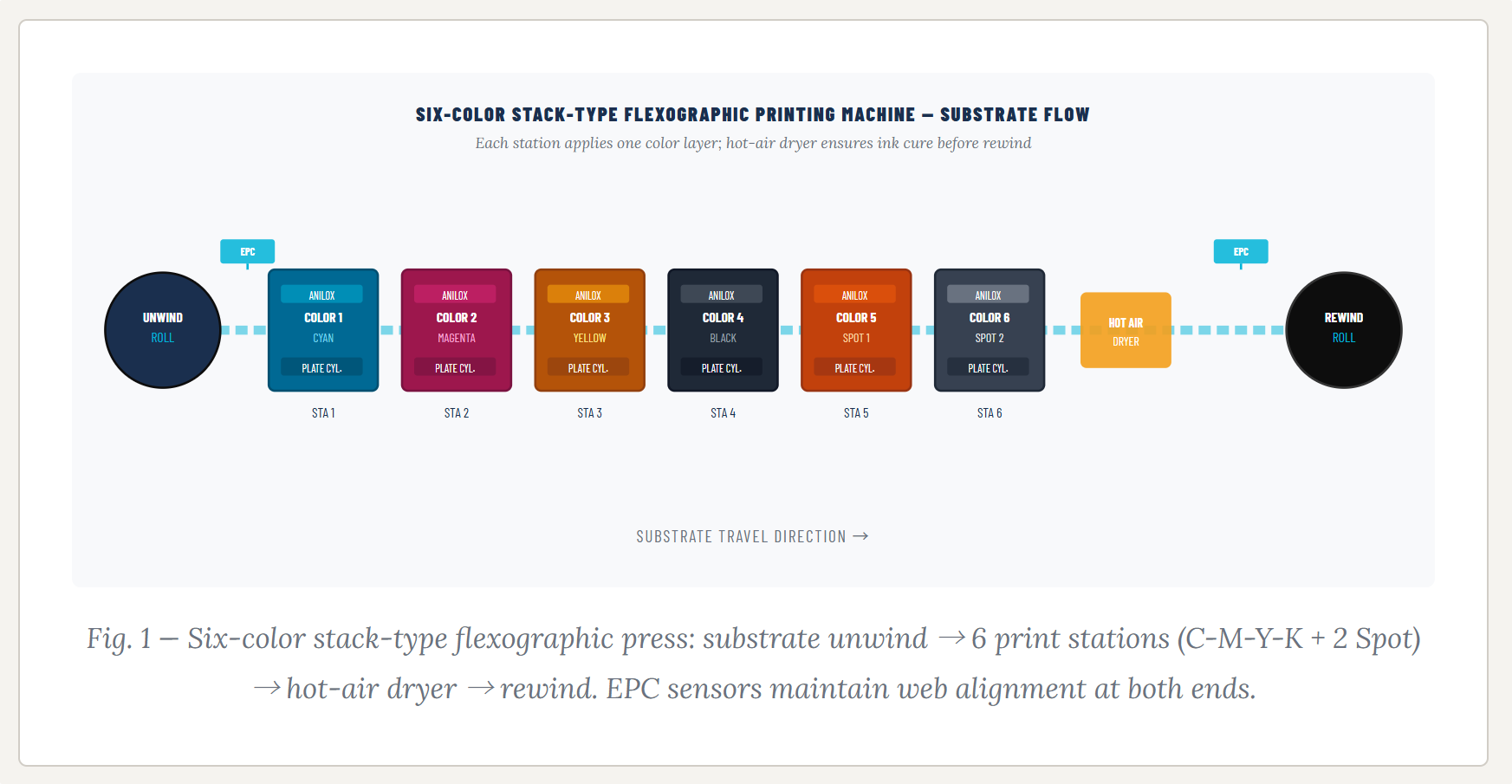
Six independent print stations arranged in a vertical stack — each applying one color in perfect register before the substrate exits through the rewind unit.
Fig. 1 — Six-color stack-type flexographic press: substrate unwind → 6 print stations (C-M-Y-K + 2 Spot) → hot-air dryer → rewind. EPC sensors maintain web alignment at both ends.
Anilox Ink Transfer System
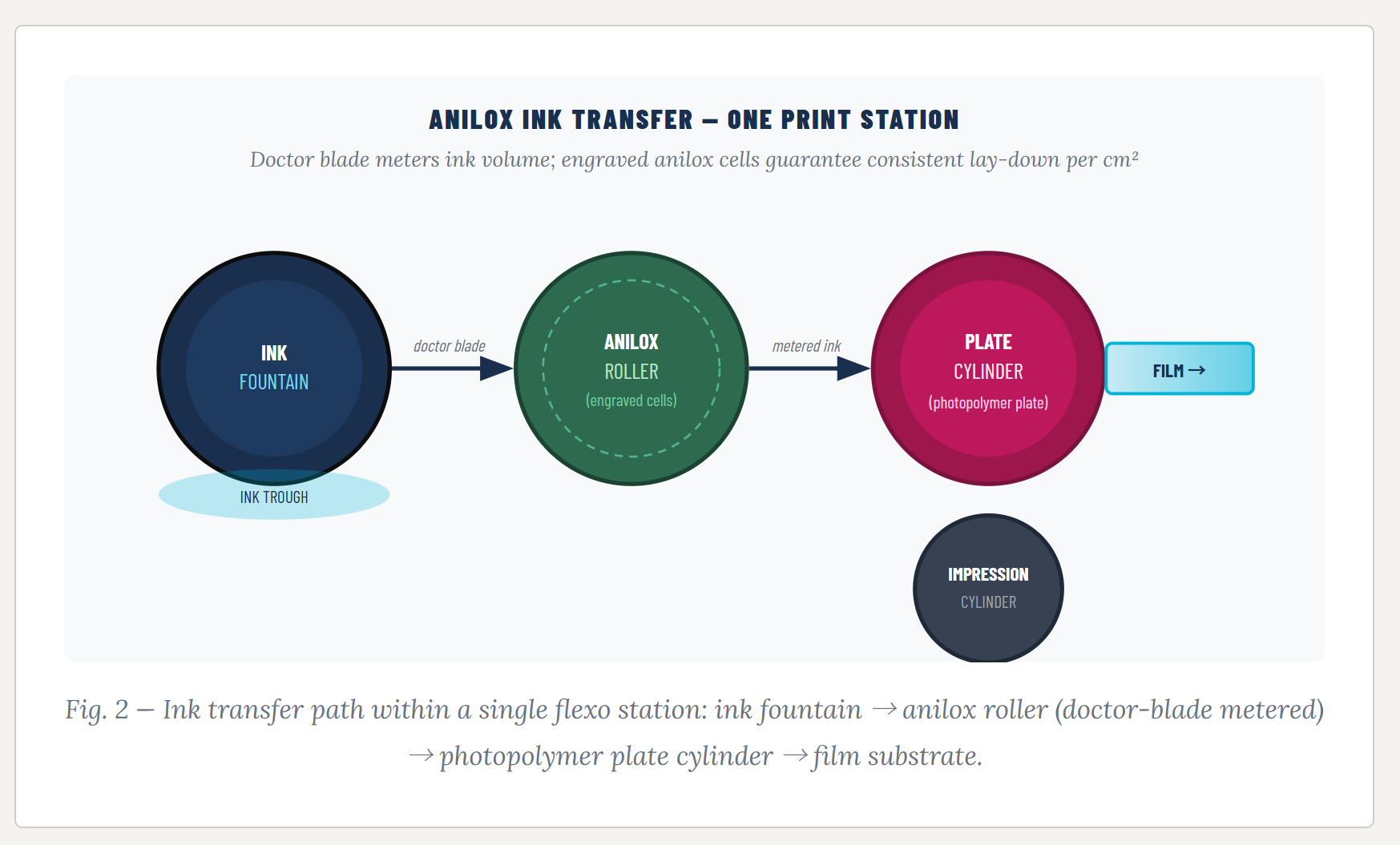
The precision of flexographic printing comes down to three rollers working in concert: the ink fountain, the anilox, and the plate cylinder.
Fig. 2 — Ink transfer path within a single flexo station: ink fountain → anilox roller (doctor-blade metered) → photopolymer plate cylinder → film substrate.
Engineering Insight: Anilox roller cell count (lines/cm) directly controls ink volume deposited per unit area. Lower cell counts (80–120 lpi) suit bold graphics and white inks; higher counts (200–400 lpi) enable fine detail and process-color halftone work on BOPP and PET films. Matching anilox specification to your artwork complexity is the single highest-impact variable in print quality.
Engineering Features That Differentiate
Not all flexo presses are equal. Here is what separates a production-grade six-color stack press from entry-level alternatives.
Servo-Driven Register Control
Each print station runs on an independent servo motor — eliminating the mechanical gear slippage that causes misregistration at high speed. Closed-loop feedback corrects longitudinal register in real time, maintaining ±0.1 mm across all six colors.
Pneumatic Cylinder Lift System
Printing cylinders engage and disengage pneumatically, not mechanically. When a station lifts, ink stirring continues automatically — preventing viscosity changes from pigment settling during brief production pauses.
Zoned Hot-Air Drying
Independent drying zones between stations ensure each ink layer is cured before the next color is applied. This is critical for solvent-based inks on PE and OPP films where inter-coat adhesion determines scuff resistance on finished packaging.
360° Longitudinal Register Adjustment
Continuous, stepless longitudinal register adjustment across the full 360° of the plate cylinder repeat — essential for long-run jobs where thermal expansion of the substrate causes print drift over time.
Digital Meter Counter & Auto-Stop
Programmable production counter stops the machine at the set print quantity or automatically on substrate breakage — reducing waste on short runs and preventing overprinting that drives up material cost.
Double Unwinder & Rewinder
Dual-position unwinder with 76 mm air shafts and 5 kg automatic tension brakes enables roll changes with minimal downtime. EPC (Edge Position Control) maintains lateral web alignment regardless of roll cone irregularities.
Technical Specifications
Standard model parameters — custom configurations available for substrate width, speed class, and ink system.
| Parameter | Standard Model | High-Speed Model |
|---|---|---|
| Number of Colors | 6 (stack type) | 6 (stack type) |
| Max. Print Speed | 80–100 m/min | 120–150 m/min |
| Max. Print Width | 600–1000 mm | 600–1200 mm |
| Max. Print Repeat Length | 300–800 mm | 300–1000 mm |
| Registration Accuracy | ±0.15 mm | ±0.1 mm |
| Substrate Thickness | 20–200 μm | 20–250 μm |
| Unwind / Rewind Diameter | Max. 600 mm | Max. 800 mm |
| Air Shaft Core Diameter | 76 mm (3 inch) | 76 mm / 152 mm |
| Ink System | Water-based or Solvent-based | Water-based, Solvent-based, or UV |
| Drying System | Hot air (single zone) | Hot air (multi-zone) + IR option |
| Plate Type | Photopolymer resin / Rubber | Photopolymer resin |
| Tension Control | Mechanical brake | Servo + automatic tension sensor |
| Power Supply | 380V / 50Hz / 3-phase | 380V / 50Hz / 3-phase (configurable) |
| Color Arrangement Options | 0+6, 1+5, 2+4, 3+3 | 0+6, 1+5, 2+4, 3+3 |
| Certification | CE | CE |
| Warranty | 1 Year (parts & labor) | 1 Year (parts & labor) |
Substrate Compatibility
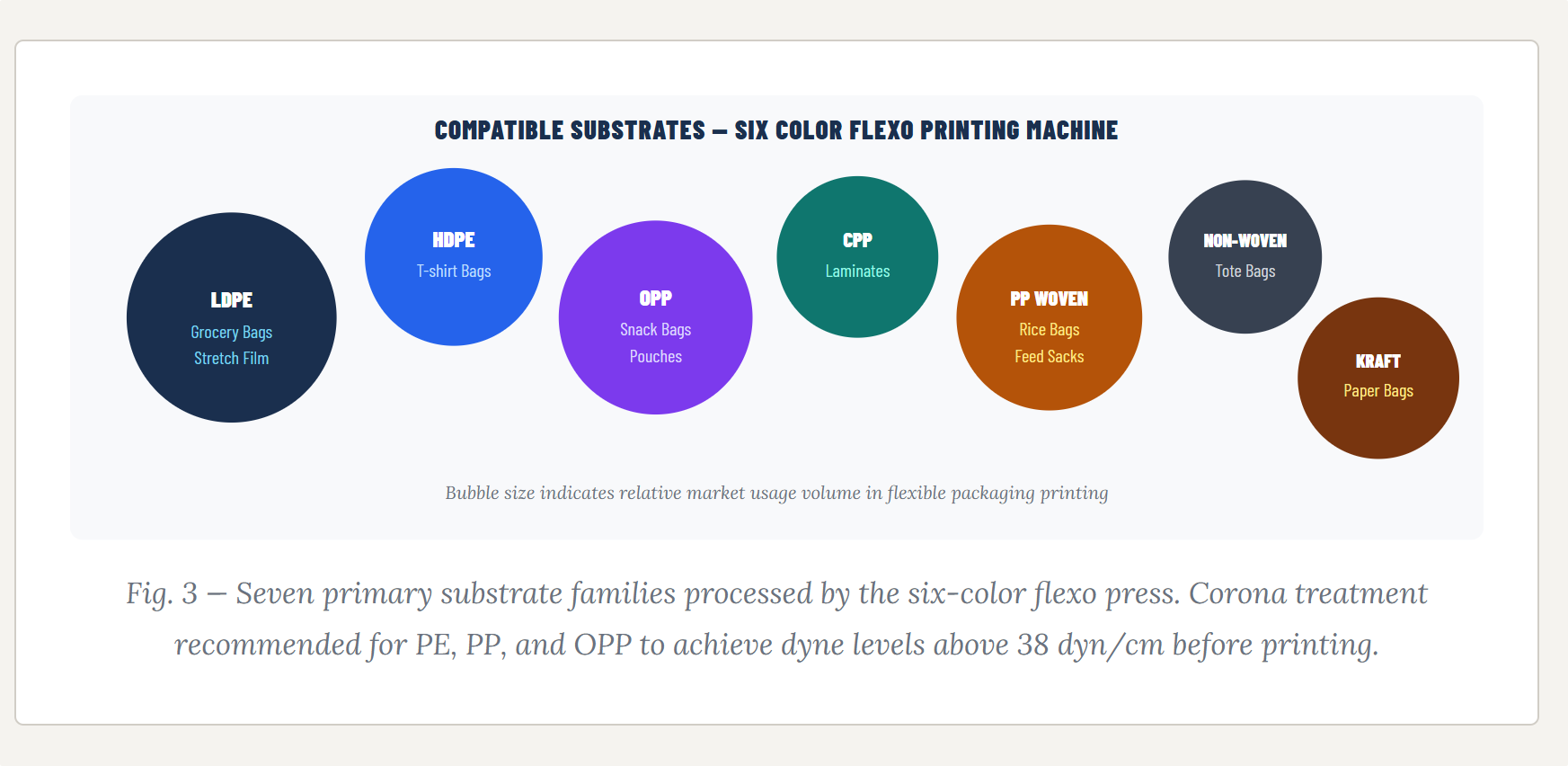
The six-color flexo press is substrate-agnostic by design. Corona pre-treatment is recommended for low-surface-energy films (PE, PP, OPP) to ensure ink adhesion above 38 dyn/cm.
Fig. 3 — Seven primary substrate families processed by the six-color flexo press. Corona treatment recommended for PE, PP, and OPP to achieve dyne levels above 38 dyn/cm before printing.
Flexo vs. Gravure vs. Digital
Buyers comparing printing technologies often focus on headline speed — but the real decision comes down to run length economics, substrate range, and total cost of ownership.
| Criterion | 6-Color Flexo ✓ | Rotogravure | Digital Inkjet |
|---|---|---|---|
| Optimal Run Length | 5,000–unlimited m | 50,000+ m | 50–5,000 m |
| Plate / Cylinder Cost | Low (photopolymer) | Very High (engraved) | None |
| Max Print Speed | 80–150 m/min | 200–400 m/min | 10–50 m/min |
| Substrate Range | Wide (film, paper, NW) | Films, foils | Limited (media-specific) |
| Water-based Ink Support | Yes (VOC-compliant) | Limited | Yes |
| Variable Data Printing | No | No | Yes |
| Makeready Time | 15–45 min | 60–120 min | 5–15 min |
| Food-Grade Ink Availability | Yes | Yes | Yes |
| Capex (6-color) | Medium | Very High | Medium–High |
Buyer's Insight: Flexographic printing dominates global flexible packaging production because it sits in the "sweet spot" — lower tooling cost than gravure, far higher throughput than digital, and a substrate range that covers 90%+ of film packaging applications. For runs above 5,000 linear meters on commodity substrates (PE, PP, OPP), a six-color flexo press almost always delivers the lowest cost-per-printed-meter.
Industry Applications
Where six-color flexographic printing creates measurable value across end markets.
Retail & Grocery
Supermarket T-shirt bags, produce bags, bread bags — high volume, consistent quality
Food Packaging
Snack pouches, coffee bags, frozen food film — water-based inks for food-contact compliance
Agricultural
Rice bags, seed sacks, fertilizer PP woven bags — heavy-duty multi-color branding
Personal Care
Shampoo sachets, wet wipe pouches, cosmetic laminates — fine halftone on OPP/CPP
Shopping Bags
Non-woven totes, kraft paper bags, vest bags — full-color branding with spot varnish
Industrial
Chemical bags, construction film, geomembrane — solvent inks on HDPE/LLDPE
From Artwork to Finished Roll — The Production Workflow
Understanding the full workflow helps buyers estimate total setup time and cost — not just machine speed.
01
Artwork Preparation & Color Separation
Files are separated into six color channels. Spot colors (Pantone references) are mapped to the available ink stations. Trapping and choke/spread values are set for the expected substrate — typically 0.1–0.15 mm on extensible PE film.
02
Plate Making (Photopolymer Exposure & Washout)
Six photopolymer plates are UV-exposed through film negatives (or direct laser imaging on digital plates), then washed and post-cured. Plate thickness is typically 1.14 mm or 2.54 mm depending on press configuration.
03
Plate Mounting & Impression Setting
Plates are mounted to cylinders with double-sided foam tape. Kiss impression is set by advancing the cylinder until ink transfers uniformly without plate distortion — critical for dot gain control in process-color work.
04
Ink Preparation & Viscosity Control
Inks are mixed to target viscosity (12–20 seconds / DIN cup #4 for most water-based systems). Viscosity is checked every 30 minutes during production and adjusted by adding fresh ink or retarder solvent as evaporation occurs.
05
Register Pull & Production Run
With substrate threaded through all six stations, the press runs at reduced speed while register is verified for each color pair. Once all stations are within ±0.1 mm, production speed is ramped to the operating target.
06
Quality Inspection & Finished Roll Winding
Inline or offline densitometers check ink density against approved proofs. Printed rolls are slit and rewound to customer specifications before transfer to the bag-making or lamination line.
Frequently Asked Questions
Answers to the questions buyers ask most before purchasing a six-color flexo printing machine.
What substrates can a six color flexo printing machine handle?
The machine processes PE (LDPE/HDPE), PP, OPP, CPP, PVC, non-woven fabrics, kraft paper, laminated paper, and cellophane rolls. Substrate thickness range is typically 20–200 microns. Corona pre-treatment is recommended for PE and PP to achieve surface dyne levels above 38 dyn/cm for reliable ink adhesion.
What is the print speed and how does it affect output?
Standard models run at 80–100 m/min; high-speed models reach 120–150 m/min. At 100 m/min with a 500 mm print repeat, that equals 12,000 bags/hour. Actual speed depends on drying capacity, substrate type, and ink system — water-based inks on PE film may require slower speeds than solvent-based inks to achieve full cure before rewind.
Can it handle both water-based and solvent-based inks?
Yes. The machine accommodates both ink systems. Water-based inks are preferred for food packaging applications due to lower VOC emissions and compliance potential with FDA indirect food contact regulations. Solvent-based inks offer stronger adhesion on low-energy surfaces and higher resistance to moisture, heat-seal, and scuff.
How accurate is color registration across all six stations?
Modern servo-driven models achieve ±0.1 mm registration accuracy. This is maintained by closed-loop EPC sensors at the unwind and rewind, plus longitudinal register adjusters (360° continuous) at each print station. Thermal substrate expansion during long runs is compensated through automatic register correction.
What plate system does the machine use?
The machine supports flexible photopolymer resin plates (the industry standard) and rubber plates. Photopolymer plates offer finer halftone resolution (up to 150 lpi) and dimensional stability. Rubber plates are more economical for simple, heavy-coverage designs. Plate thickness is typically 1.14 mm or 2.54 mm; sticky-back foam tape thickness must be selected accordingly.
What after-sales support is provided?
A one-year warranty covers parts and workmanship. Factory engineers provide on-site installation and commissioning. Remote video support, spare parts supply (including anilox rollers, doctor blades, air shafts), and optional extended service contracts are available. Response time for critical spares is typically 3–7 business days via international courier.
Complete Your Production Line
The six-color flexo press is typically integrated upstream or downstream of these complementary machines.
Film Blowing Machine
Produces the PE/PP film substrate that feeds the flexo press. Matching blown film output width to print width eliminates the slitting step and reduces material waste.
Bag Making Machine
Receives printed film rolls from the flexo press and converts them into finished bags — T-shirt, flat, side-seal, or bottom-seal configurations depending on market requirement.
Lamination Machine
Bonds printed film to a second substrate (BOPP, PET, or aluminum foil) to create multi-layer flexible packaging with barrier properties for food and pharma applications.
Ready to Configure Your Six-Color Flexo Press?
Tell us your substrate type, print width, and production speed target — and we'll recommend the right model, anilox specification, and ink system for your application.