Previous
Next
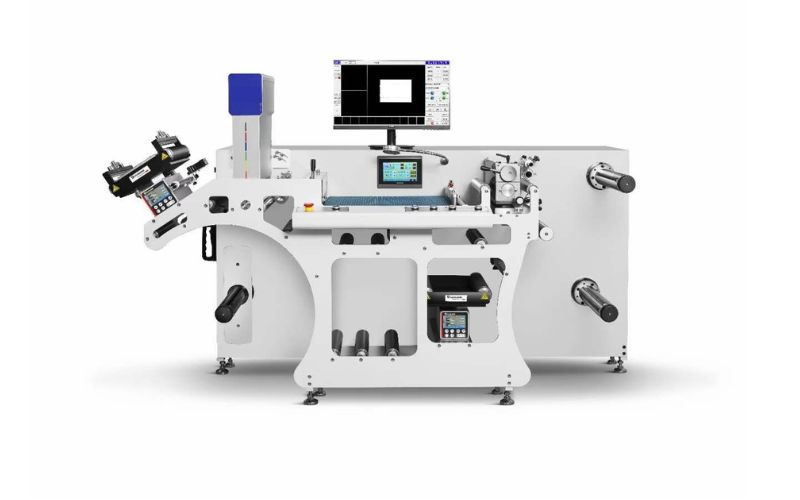
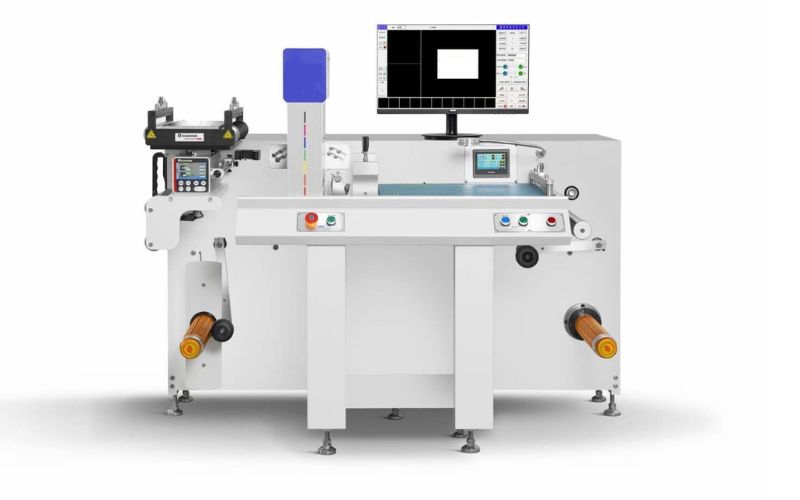
Automatic Sticker Paper Label Quality Inspecting Machine With Slitting Rewinding System
- Auto stop when find detects
- Can be with slitting funcation
Description
Quality Inspection Equipment
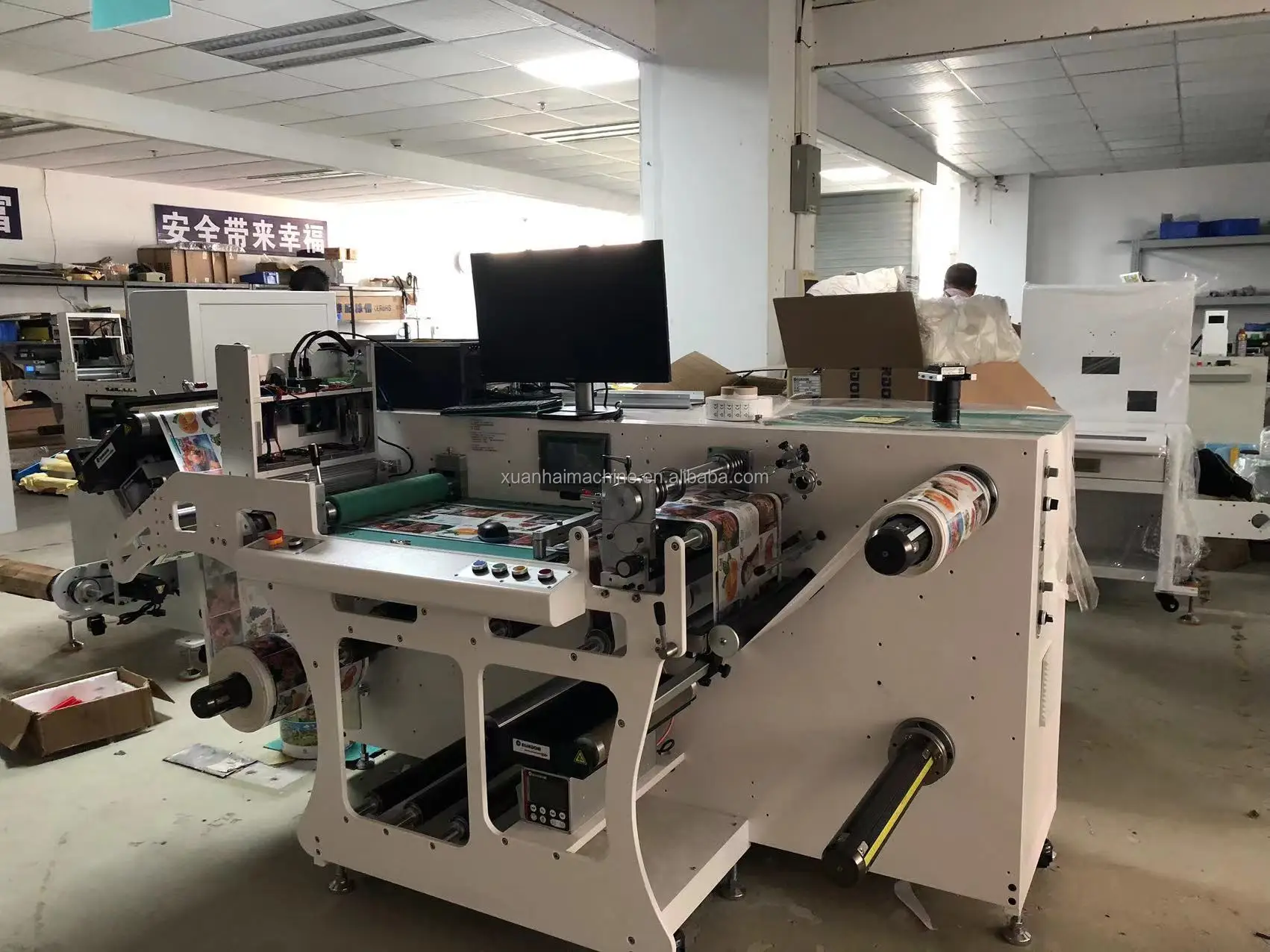
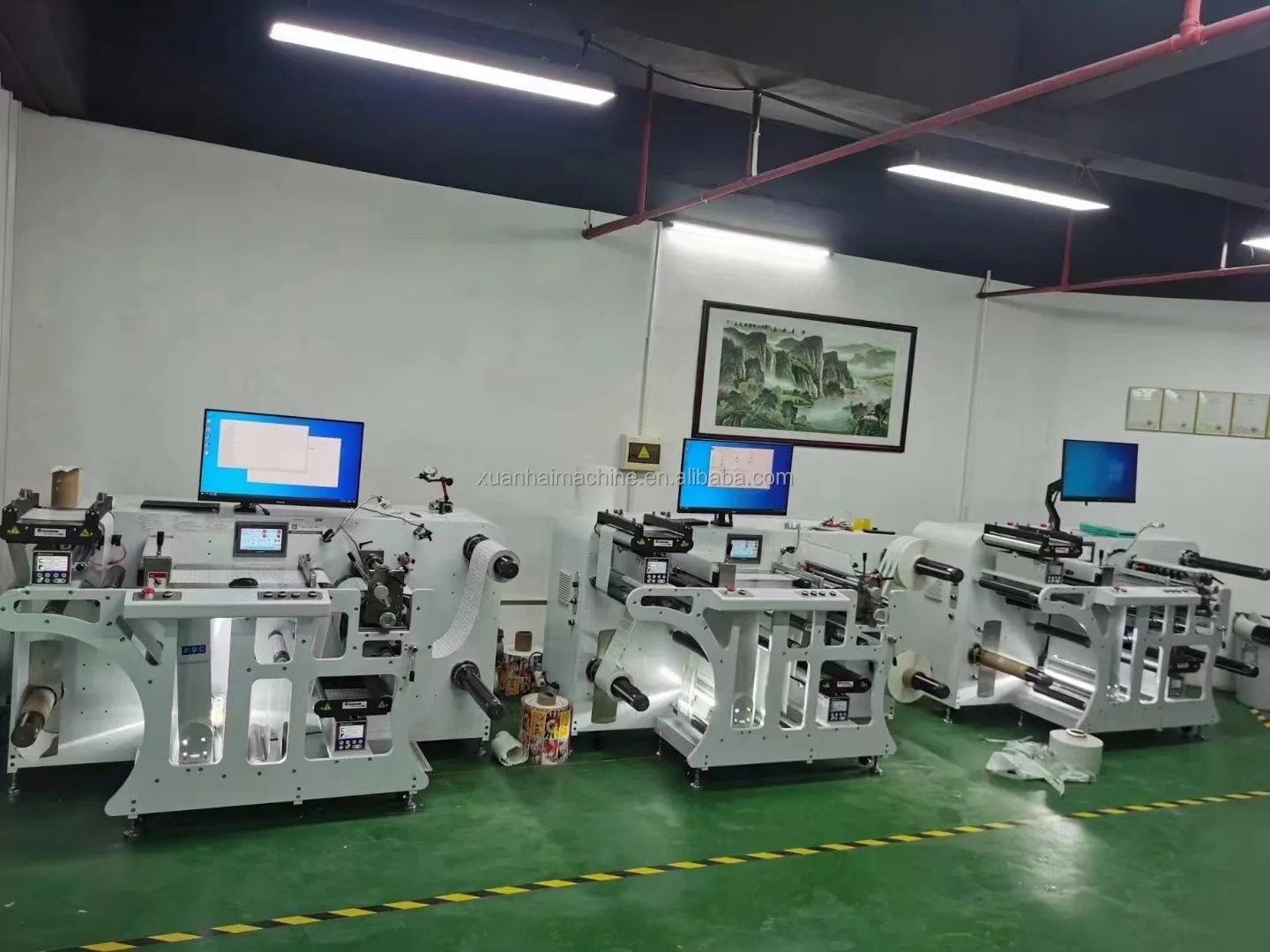
Automatic Sticker Label Quality Inspection Machine
Industrial-grade label defect detection using high-resolution linear CCD cameras. Catches 12+ defect types invisible to the human eye — at speeds up to 150 meters per minute, with automatic rejection and roll rewinding.
✓ 100% Inline Inspection ✓ AI Vision Algorithm ✓ 150 m/min Max Speed ✓ Zero-Stop Defect Rejection ✓ ISO 9001 Certified
Machine in Action
See the Inspection System Operating at Full Speed
Watch how the machine captures, analyses, and auto-rejects defective label sections in real time — with zero operator intervention required during a production run.
Full-speed production demo — automatic label inspection, defect marking, and rewinding on a 120m/min BOPP label run.
Inspection Workflow
How the 5-Stage Inspection Process Works
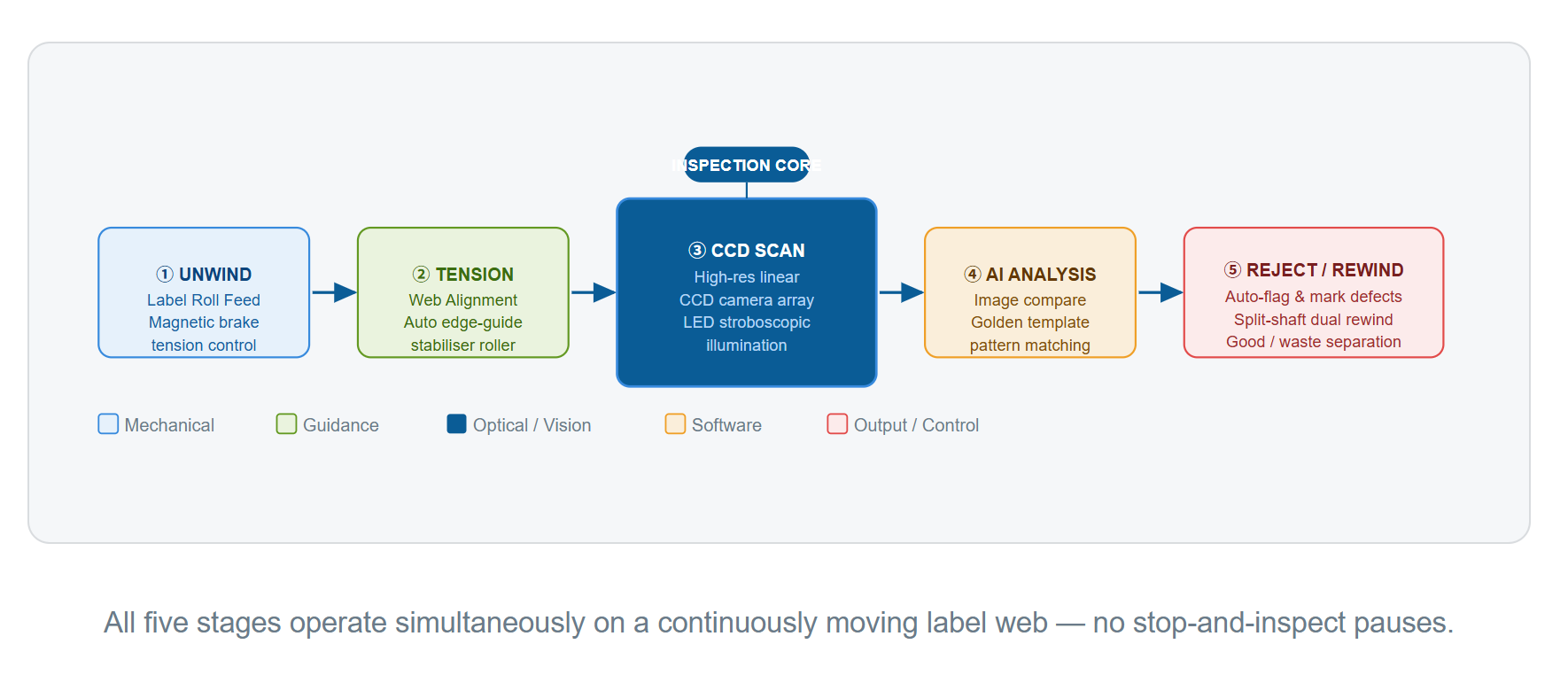
Unlike single-pass visual checkers, this system runs five coordinated analysis stages simultaneously on every label — reducing false rejects while maximising genuine defect capture.
Defect Detection Capability
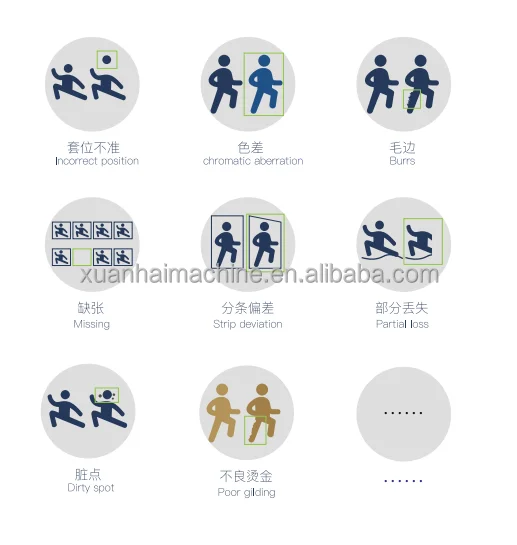
12 Categories of Label Defects Detected Automatically
Conventional in-line checkers miss defects smaller than 0.5mm or fail on metallic and transparent substrates. This machine's adaptive threshold algorithm re-calibrates for substrate reflectivity in real time, delivering consistent detection across all label materials.
Missing Print
Blank areas where ink or coating should be present
Ink Splash / Contamination
Stray ink dots or solvent drops outside printed zones
Color Register Error
Misalignment between colour separation layers ≥0.15mm
Color Difference (ΔE)
Density deviations exceeding configurable ΔE tolerance
Streaks & Banding
Horizontal or vertical streaks from worn anilox or plate
Spots & Pinholes
Micro-voids in solid coverage areas; pinhole detection ≥0.1mm
Edge Deviation
Label cut edge outside tolerance on die-cut or slit labels
Folded / Creased Material
Web fold-overs and crease lines in the substrate or liner
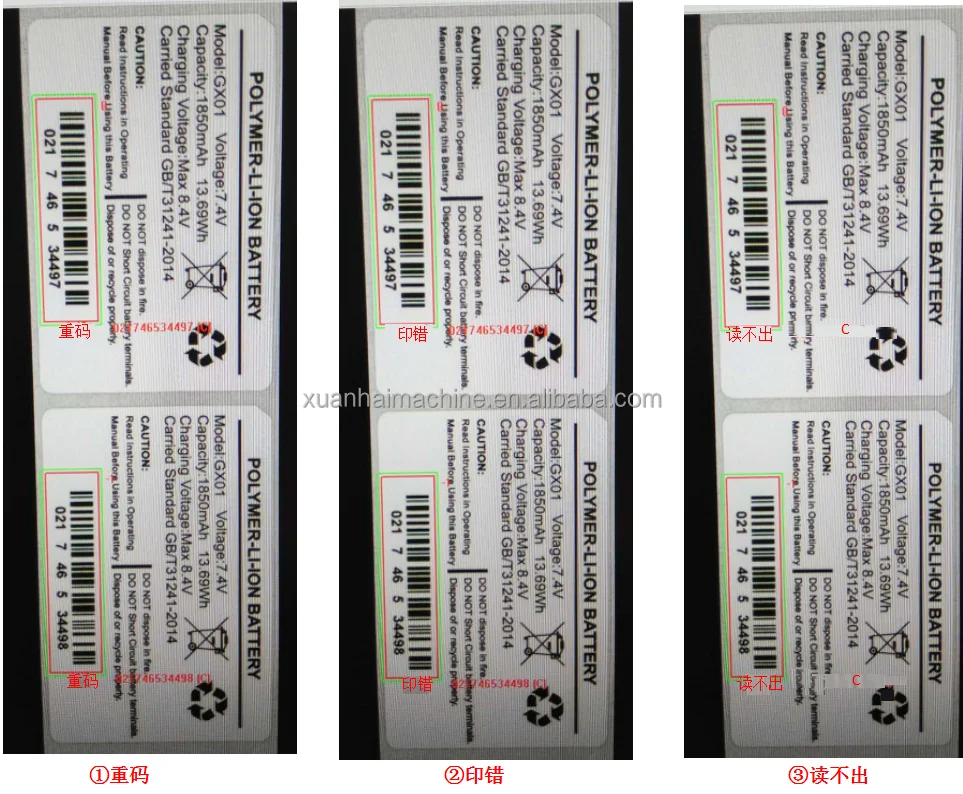
Barcode Grading
ISO 15416 barcode quality grading; rejects below Grade C
Reversed / Mirrored Label
Labels inserted with wrong orientation detected by pattern comparison
Date / Lot Code Error
OCR verification of variable data fields against master template
Adhesive Bleed
Adhesive migration beyond label boundary — common on hot climates
Technical Data
Full Technical Specifications
All parameters are independently adjustable via the 10.4-inch touchscreen HMI. Sensitivity profiles can be saved per job and recalled instantly at changeover.
| Parameter | Specification |
|---|---|
| Inspection Speed | 10 – 150 m/min (adjustable) |
| Web Width | 50 – 350 mm |
| Roll Outer Diameter (max) | Unwind: ∅600 mm / Rewind: ∅500 mm |
| Core Diameter | 3" / 6" (76mm / 152mm) — interchangeable |
| Camera System | High-resolution linear CCD, 4096 × 1 pixels per scan line |
| Illumination | LED stroboscopic array, front + back lighting optional |
| Minimum Defect Detection | ≥ 0.1mm × 0.1mm (substrate dependent) |
| Color Deviation Threshold | Configurable ΔE 1–10 (CIE Lab) |
| Barcode Standards | ISO 15416, ISO 15415, GS1-128, QR, Data Matrix |
| Tension Control | EPC edge-position control + magnetic particle brake/clutch |
| HMI | 10.4" industrial touchscreen, Windows-based software |
| Data Output | PDF defect report per roll, CSV export, real-time OEE display |
| Communication | EtherNet/IP, RS-232, USB, optional OPC-UA |
| Power Supply | 3-phase 380V / 50Hz (220V / 60Hz available) |
| Machine Dimensions (L×W×H) | Approx. 1,800 × 900 × 1,500 mm |
| Machine Weight | Approx. 680 kg |
| Certifications | CE, ISO 9001:2015 |
Why This Machine
What Sets This System Apart from Conventional Label Checkers
Most label inspection machines compare only against a static bitmap reference. This system uses a multi-layer analysis engine that compensates for print-to-print natural variation — eliminating the false-reject problem that plagues single-threshold systems.
Adaptive Threshold Engine
The system builds a statistical tolerance band from the first 20 labels of each run. Subsequent labels are judged against this learned baseline — not a rigid factory-set template. False-reject rates under 0.03% in production.
Zero-Interruption Reject Mode
Defective sections are marked with a photo-eye flag and automatically routed to a separate waste core during rewinding. The web never stops — production OEE is maintained even during defect events.
Dual-Channel Lighting
Switchable front-light and back-light modes in the same pass. Opaque substrates use front illumination; transparent or translucent films use back-lit mode to reveal bubble and void defects invisible under front light alone.
Roll-Level Traceability Report
Every roll produces a timestamped PDF with defect location maps, defect type breakdown, and OEE metrics. GMP-compliant report format accepted by FDA 21 CFR Part 11 and EU GMP Annex 11 auditors.
Material-Agnostic Operation
Works on paper, BOPP, PET, metallised film, holographic foil, and linerless labels without changing optics or configuration — only the lighting mode switches automatically based on opacity sensor reading.
Remote Diagnostics Ready
Integrated VPN module enables PouchesMachine engineers to perform remote diagnostics and algorithm updates — reducing on-site service calls by an average of 60% compared to traditional field-service models.
Industries Served
Proven Across Regulated and High-Volume Label Applications
Label converters, brand owners, and contract packagers in the following sectors rely on automatic vision inspection to meet customer quality agreements and regulatory requirements without adding manual headcount.
Pharmaceutical & GMP Food & Beverage Cosmetics & Personal Care Wine & Spirits Chemical & Hazmat Medical Device Labelling Logistics & Shipping Labels Electronics & PCB Labels Flexographic Label Converters Digital Inkjet Label Print Offset Label Print Narrow-web Tag & Label
Pharmaceutical Note
For pharmaceutical label inspection under EU GMP Annex 1 and FDA 21 CFR Part 211.122, this machine supports electronic batch records, access-control audit trails, and electronic signatures — removing the need for manual 100% visual inspection of label printing lots.
Frequently Asked Questions
Common Questions About Label Inspection Machines
Questions sourced from label converters and brand owners evaluating vision inspection systems for the first time, as well as buyers upgrading from legacy stroboscopic manual-checkers.
What types of label defects can this machine detect?
The system detects 12 primary defect categories: missing print, ink splash, colour register deviation, colour density difference (ΔE), streaks and banding, spots and pinholes, edge deviation, substrate fold/crease, barcode grade failure (ISO 15416), reversed label orientation, variable data / OCR error, and adhesive bleed beyond die-cut edge. Custom defect classes can be added through the software's region-of-interest editor.
How is the machine set up for a new label job?
A golden-sample run of 20 labels establishes the tolerance baseline automatically. The operator names the job and saves it. Future changeovers recall the profile in under 60 seconds. No manual ROI drawing is required for standard label layouts — the system auto-detects print zones from the golden sample.
Can it inspect clear / transparent labels?
Yes. The dual-channel LED illumination system switches to back-lit mode for clear BOPP, PET, and linerless materials. The machine's opacity sensor triggers the mode switch automatically when a new roll is loaded, without requiring operator input.
Does the machine integrate with MES or ERP systems?
Yes. The OPC-UA and EtherNet/IP interfaces allow the machine to push roll-level quality data (defect count, defect type, OEE) directly to SAP, Oracle, Tulip, or any standards-compliant MES. Roll reports are also exported as CSV for custom reporting pipelines.
What is the typical return on investment for a label inspection machine?
Label converters typically recover machine cost within 12–18 months through three channels: elimination of customer charge-backs for defective label deliveries (often $5,000–$50,000 per incident in regulated industries), reduction of manual inspection headcount (typically 1–3 operators per shift), and reduced waste from earlier defect detection versus end-of-line checking. The pharmaceutical and food sectors typically see the fastest ROI due to high charge-back exposure.
What warranty and after-sales support is provided?
PouchesMachine provides a 12-month parts warranty with optional extension to 36 months. Remote diagnostics via VPN are included for the first year. On-site installation, commissioning, and operator training is included in the purchase price for most regions. Spare camera modules and LED arrays are stocked for same-week dispatch.
Related Equipment
Complete the Label Quality Line
The inspection machine integrates directly upstream or downstream of PouchesMachine's label slitting, rewinding, and sleeve shrink-cut systems — forming a complete label quality workflow with a single supplier.
Ready to Eliminate Label Defect Escapes?
Talk to a specialist about inspection speed, substrate compatibility, and integration with your current label production line. Most customers receive a formal proposal within 48 hours.