
Why South America Is the Next Flexo Frontier
The global flexographic printing market is growing rapidly, driven by demand from food and beverage, pharmaceutical, and consumer goods sectors. Within this expansion, South America stands out as a particularly dynamic market. Brazil, Argentina, Chile, and Colombia have all seen significant recent investment in flexible packaging and label production infrastructure — including high-profile installations of stack-type flexo presses at major converters in São Paulo and Buenos Aires.
For businesses looking to enter or expand in this environment, the right entry-level machine is not simply the cheapest available option. It is the configuration that best balances initial capital cost against production versatility, substrate compatibility, and long-term scalability.
Stack Type vs. CI vs. Unit Type: Which Configuration Is Right?
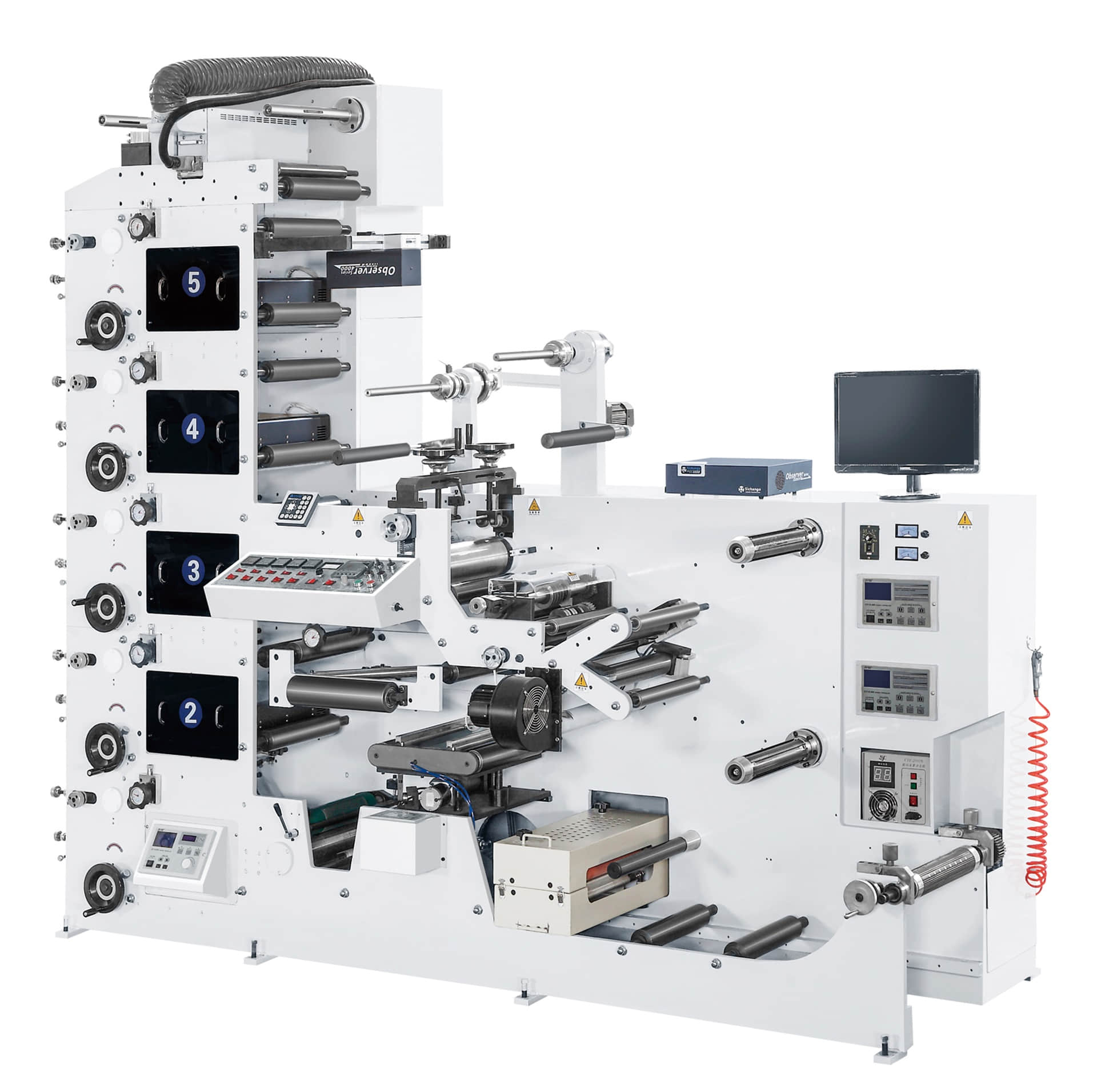
Fig. 1 — Press type comparison: Stack (left), Central Impression (center), Unit/Inline (right). Stack presses deliver the most compact, cost-effective solution for SME label and packaging production.
4–6 m compact footprint
Lower initial investment ($20K–$80K)
Modular — add units as you grow
Prints both sides of substrate
Fast job changeovers for short runs
Widely serviced across South America
80–120 m/min max speed
Registration less precise than CI on thin films (<25 µm)
Not ideal for ultra-long production runs
UV heat can stress heat-sensitive films
Core Printing Specifications: What to Require
Web Width: 320mm Minimum
The 320mm web width is the industry standard for entry-level narrow-web flexo printing. This width is sufficient for self-adhesive labels, BOPP wrap-around labels, shrink sleeves, and flexible packaging films. Many Chinese manufacturers offer 320mm as standard, with upgrade options to 450mm or 560mm. Always confirm maximum web width — not nominal — in supplier quotations.
UV Curing: 6 Independent Stations
Six UV curing stations with independent lamp control is the feature most frequently misrepresented in supplier specifications. On budget machines, all UV lamps are often linked to a single on/off circuit, meaning you either run all six lamps or none. This wastes energy and exposes heat-sensitive substrates unnecessarily.
When requesting quotations, specifically ask: "Can each UV lamp station be independently switched on/off and have its intensity adjusted via PLC signal?" If the answer involves a single master switch, reject the specification. Independent control is non-negotiable for multi-substrate operations.
For customers requiring maximum future flexibility, hybrid UV systems accepting interchangeable cassettes for both LED and mercury-arc UV curing allow operators to position curing units freely and switch technologies as inks and substrates evolve. LED UV delivers 50–70% energy savings over mercury-arc, with significantly longer lamp life (10,000+ hours vs. 1,000–2,000 hours for mercury lamps).
Anilox Rollers: Three LPI Options
The anilox roller determines ink volume and print quality more than almost any other component. Specify only ceramic laser-engraved anilox rollers — never chrome. Chrome anilox cells wear rapidly, losing volume and transfer consistency, especially in solvent and UV ink systems.
| LPI Value | Ink Volume | Best Application | Relative Cost |
|---|---|---|---|
| 400 LPI | High | Opaque whites, flood coats, heavy solid coverage, primers | Baseline |
| 600 LPI | Medium | General purpose label and packaging, spot colors, solid fills | +15–20% |
| 800 LPI | Low–Medium | Fine halftones, process color CMYK, premium brand labels, fine text | +30–40% |
Some suppliers quote "800 LPI equivalent" rollers manufactured using electromechanical engraving rather than laser engraving. Electromechanically engraved ceramic cells have inconsistent geometry and lower cell volume precision. Always specify "ceramic laser-engraved" explicitly in your purchase order and request an engrave certification with cell volume measurements.
South America Electrical Compliance: The Detail Most Buyers Miss
This section represents genuinely differentiated guidance not found in most supplier brochures. Electrical compatibility between your press and local grid infrastructure is not a formality — it is one of the most frequent causes of installation delays and unexpected cost overruns for South American buyers.
Fig. 2 — South America electrical standards by country. Brazilian and Colombian buyers must specify 60Hz compatibility or budget for a frequency converter at installation.
Total Connected Load: Budget Your Infrastructure
A 6-color stack flexo press with six UV curing lamps draws 25kW to 45kW total connected load. The UV system alone accounts for 12–30kW, depending on lamp wattage (2–5kW per station). Request a full power budget breakdown from every supplier — not just the headline "total kW" number — including:
Main drive motor rated power (kW) and peak demand
UV lamp power per station and total UV system load
Corona treater power draw and duty cycle
Compressed air requirements (L/min at specified bar pressure)
Control voltage (typically 24VDC) transformer capacity
HVAC/extraction ventilation power for UV ozone management
Essential Components: What Separates Professional from Budget Configurations
Corona Treatment: Non-Negotiable for Film Substrates
Corona treatment is frequently listed as an "optional accessory" in entry-level press quotations. For any operation printing on BOPP, PE, PET, or PP films, it is mandatory infrastructure. Untreated polyethylene has surface energy of just 31 dynes/cm, and untreated polypropylene sits at 29 dynes/cm — far below the 38–42 dynes/cm minimum required for reliable ink adhesion. Without adequate corona treatment, ink will crawl, pinhole, and delaminate in service.
Differentiated insight: Many buyers specify corona treatment without specifying treatment width. Ensure the corona electrode spans the full web width (320mm+), not just the central zone. Narrow electrodes create untreated edge strips that cause label peel failures — a common quality complaint in South American food packaging converters.
Tension Control: Mitsubishi Standard and What to Verify
Mitsubishi auto-tension controllers for unwinder and rewinder are the recognized industry standard for closed-loop web tension regulation. Verify that quotations specify "Mitsubishi Japan" origin units — not rebranded local copies or lower-tier alternatives from other Asian suppliers that superficially resemble Mitsubishi hardware.
Rotary Die-Cutting: First Station Now, Second Station Later
In-line rotary die-cutting eliminates a separate converting step, improving throughput and ensuring consistent registration between printing and die-cutting. For entry-level configurations, one rotary station handles most label applications. When evaluating presses, confirm the mechanical provision for a second die-cutting station is already built into the frame — retrofitting die-cut capacity to a press not originally designed for it is expensive and often mechanically compromised.
2026 Pricing: What to Expect at Each Tier
LED UV systems cost $5,000–$15,000 more upfront than mercury-arc equivalents, but reduce per-hour UV operating cost by 50–70% and eliminate lamp replacement cycles (mercury lamps: 1,000–2,000 hours; LED: 10,000+ hours). Over five years of two-shift operation, LED UV typically returns a net saving of $30,000–$60,000 in energy and consumables — more than offsetting the initial premium.
Supplier Selection: Five Questions to Ask Before You Sign
| # | Question to Ask | What a Good Answer Looks Like |
|---|---|---|
| 1 | How many presses have you installed in South America in the last 3 years? | Reference list with company names and locations in Brazil/Argentina/Chile. Offer to provide customer contacts. |
| 2 | Who provides on-site service if a UV lamp fails in our city? | Named local authorized service partner with guaranteed response time (e.g., within 48 hours). Spare parts in regional warehouse. |
| 3 | Can I see the electrical panel and control wiring diagrams before order? | Yes, with full EPLAN or CAD documentation. Reluctance to share pre-sale is a red flag. |
| 4 | Are your Mitsubishi tension controllers on the invoice as "Mitsubishi Japan" with serial numbers? | Yes — and they will match the Mitsubishi Japan serial database. Ask for pre-shipment photos. |
| 5 | What is the lead time for a replacement UV ballast to our city? | Concrete answer in days, with DHL or courier tracking. "We can send in 2–3 weeks from China" is not acceptable without local buffer stock. |
Spare Parts Kit: The Items Your Supplier Won't Volunteer
The minimum spare parts kit specified for South American markets should include 2x spare UV bulbs, 1x spare UV ballast, and a complete set of fuses and sensors. However, most converters who have operated in the region for more than 12 months recommend extending this initial kit significantly:
2× spare UV bulbs per station (not just 2× total across the machine)
1× spare UV ballast (electronic type if the machine uses electronic ballasts)
Full fuse and sensor complement (map these to the electrical schematic on arrival)
3× doctor blade sets per color (stainless steel and plastic)
2× corona treatment electrode insulator sets
6× printing plate mounting tape rolls (appropriate tack for your substrate mix)
1× set drive belts for main drive system
2× anilox cleaning brushes per roller size
Regional reality: Express shipping from China to São Paulo, Buenos Aires, or Santiago typically takes 5–10 business days via DHL, but customs clearance can add 5–15 days for industrial spare parts. A single UV ballast failure without a local spare can cost a converter 3–4 weeks of downtime. Budget approximately 3–5% of machine purchase price for an initial regional spare parts stock.