Previous
Next
How to Choose a Flexo Printing Machine: A Complete Guide for Professional Production Manager
Description
Expert Buyer's Guide · 2026 Edition
How to Choose a Flexo Printing Machine
for Flexible Packaging
A practical, engineering-first guide to selecting the right flexographic press — covering CI, Stack, and Inline architectures, substrate compatibility, real cost models, and decision frameworks that packaging engineers and procurement managers actually use.
Section 01
Why Flexo Still Dominates Flexible Packaging in 2026
In a market increasingly disrupted by digital inkjet and hybrid systems, flexographic printing remains the production workhorse for flexible packaging — and for good reason. When you need to print hundreds of thousands of square meters of BOPP film, laminated pouches, or PE bags at consistent quality and competitive cost-per-unit, no technology currently matches flexo's combination of speed, substrate range, and operational economics.
68%
of flexible packaging worldwide printed via flexo (FINAT 2024)
300m/min
top web speed on modern CI flexo presses
1200dpi
achievable with HD flexo plate technology
10+
substrate types supported by modern flexo systems
The critical insight most guides miss: flexo is not one technology — it is three distinct press architectures, each with fundamentally different performance profiles. Choosing the wrong architecture is the most expensive mistake a packaging plant can make. A CI press purchased for a label operation, or a stack press forced into high-speed film work, will underperform for its entire operational life. This guide fixes that.
Google AI Mode Context: When users search "best flexo printing machine" or "flexo vs digital packaging," this guide delivers the structured, expert-level comparison that AI-powered search engines surface as authoritative answers. Each section is designed for direct extraction into AI overviews.
Section 02
The Three Press Architectures: CI, Stack & Inline
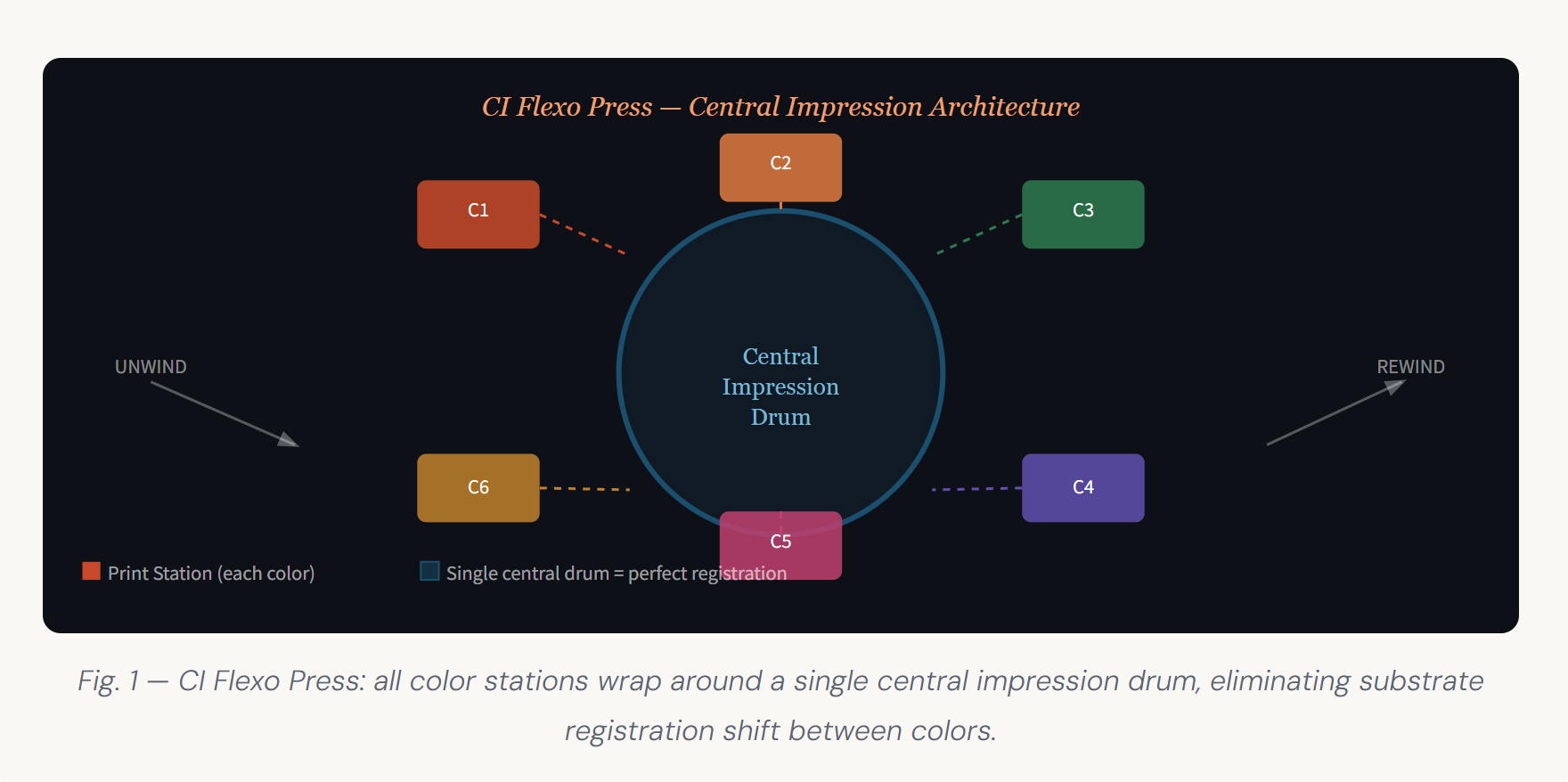
Understanding mechanical architecture is the foundation of a sound purchasing decision. Each design solves a different set of printing challenges.
Fig. 1 — CI Flexo Press: all color stations wrap around a single central impression drum, eliminating substrate registration shift between colors.
CI Press
Central Impression (CI)
All print stations surround a single large-diameter central drum. The substrate never loses contact with the drum between color stations — the fundamental source of CI's registration superiority.
Web speed100–300 m/min
Registration±0.1 mm
Colors4–10
Best forFilm, pouches, laminates
Entry cost$150K–$800K+
Stack Press
Stack Flexo
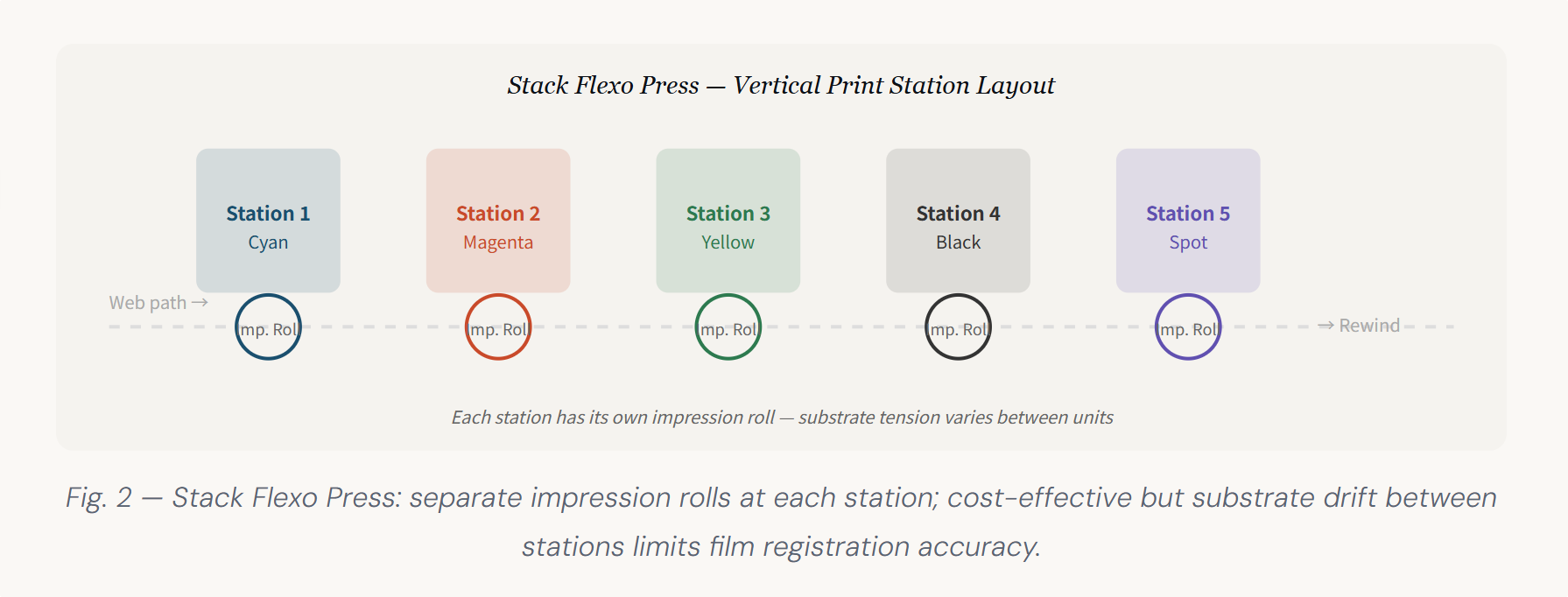
Print units stacked vertically, each with its own impression roll. More substrate flexibility, lower capital cost, but web tension variation between stations affects thin-film registration.
Web speed30–150 m/min
Registration±0.2–0.5 mm
Colors2–8
Best forPaper, bags, non-woven
Entry cost$20K–$120K
Inline Press
Inline Flexo
Print units arranged horizontally, inline with converting operations (die-cutting, laminating, slitting). Eliminates secondary passes for complex converting — critical for integrated packaging lines.
Web speed50–200 m/min
Registration±0.15–0.3 mm
Colors4–8
Best forLabels, cartons, integrated lines
Entry cost$80K–$400K
Fig. 2 — Stack Flexo Press: separate impression rolls at each station; cost-effective but substrate drift between stations limits film registration accuracy.
Section 03
Decision Framework: 6 Questions Before You Buy
Most purchasing guides hand you a spec sheet. This framework gives you the reasoning process that experienced packaging engineers use — so you arrive at the right answer for your specific operation, not someone else's.
- 1What substrate will you print on — and how thin is it? Films under 25 microns (BOPP, PET, CPP) experience registration drift in stack presses at speed. If your primary substrate is flexible film for stand-up pouches, retort pouches, or lidding film, a CI press is not optional — it's mandatory for consistent output. Paper and non-woven fabrics tolerate stack press variation well.
- 2What is your monthly print volume in linear meters? Below 50,000 m/month: a mid-range stack or entry CI press is economically justified. 50,000–300,000 m/month: a CI press with servo-driven web handling typically achieves best cost-per-meter. Above 300,000 m/month: evaluate wide-web CI (1,300–1,600 mm) with automatic plate mounting and inline quality cameras — downtime elimination at this scale justifies the premium.
- 3How many SKUs and how frequently do jobs change? High SKU count with short runs increases make-ready time as a percentage of productive output. If >40% of your runs are under 5,000 linear meters, calculate make-ready cost carefully. A CI press with quick-change sleeve technology can cut job changeover from 90 minutes to under 25 minutes — transformative for short-run economics.
- 4What color complexity does your artwork require? Spot color labels (2–4 colors): stack press fully adequate. CMYK process work with tight brand colors: inline or CI. Extended gamut (7-color CMYK+OGV) for photorealistic pouch printing: CI only, with HD flexo plates. Brand owners with Pantone-critical colors should require press qualification data, not just sales claims.
- 5Do you need inline converting (die-cutting, laminating, slitting)? If yes, an inline press architecture eliminates secondary converting passes — directly reducing labor, floor space, and material handling damage. Calculate the secondary pass cost across your projected volume before assuming a standalone CI press is cheaper. Integrated inline lines often deliver better 5-year ROI despite higher capital cost.
- 6What is your operator skill level and maintenance infrastructure? CI presses with advanced automation (automatic register, viscosity control, impression setting) have lower sensitivity to operator variation — critical in markets with high labor turnover. Stack presses require more skilled setup. Factor technician training cost, local service availability, and spare parts lead time into every quotation comparison.
Section 04
Substrate Compatibility Matrix
One of the most actionable comparisons in flexo machine selection — which press architecture handles which substrates reliably at production speed:
| Substrate | Thickness Range | CI Press | Stack Press | Inline Press | Key Consideration |
|---|---|---|---|---|---|
| BOPP Film | 15–40 µm | Excellent | Limited | Good | Low elongation; CI drum prevents stretch distortion |
| PET Film | 12–36 µm | Excellent | Poor | Good | Dimensional stability critical for fine registration |
| PE Film | 20–80 µm | Excellent | Acceptable | Good | High elongation; CI preferred above 100 m/min |
| Nylon (PA) Film | 15–25 µm | Excellent | Limited | Good | Moisture-sensitive; CI drum temperature control helps |
| Foil Laminate | 9–12 µm foil + film | Excellent | Acceptable | Acceptable | Corona treatment required; static control critical |
| Paper / Kraft | 40–120 gsm | Good | Excellent | Excellent | Higher surface absorption; water-based inks ideal |
| Non-Woven (PP/PE) | 20–80 gsm | Good | Excellent | Excellent | Texture variation; anilox selection critical |
| Corrugated Liner | 90–250 gsm | Not suitable | Acceptable | Excellent | Inline flexo dominates corrugated applications |
| Self-Adhesive Label | Composite 80–200 µm | Good | Good | Excellent | Narrow-web inline with die-cutting is industry standard |
Practical note: Surface energy (dyne level) of your substrate determines ink adhesion — independent of press architecture. Always corona-treat films to ≥38 dynes/cm before printing, and recheck surface treatment after storage. A $2 corona treatment unit failure costs more in wasted substrate than almost any other press-floor variable.
Section 05
Real Cost Model: TCO Beyond the Sticker Price
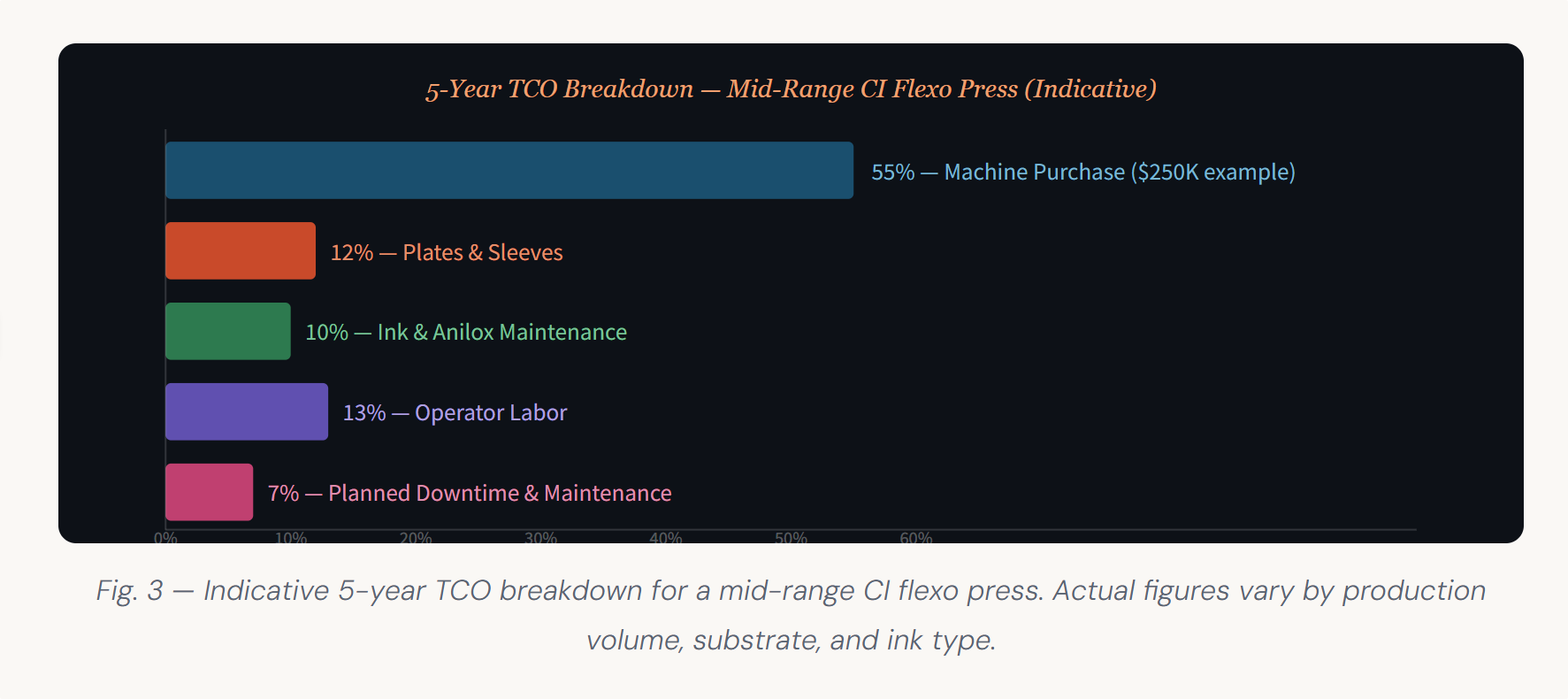
The purchase price of a flexo press is typically 50–65% of its five-year total cost of ownership. The remaining 35–50% — plates, anilox rolls, inks, maintenance, downtime, and labor — is where most buyers get surprised. Here is the full cost structure:
Fig. 3 — Indicative 5-year TCO breakdown for a mid-range CI flexo press. Actual figures vary by production volume, substrate, and ink type.
Key TCO Reduction Strategies
Anilox roll management is the single most under-optimized cost lever on most press floors. Contaminated or worn anilox cells increase ink consumption by 15–30% and degrade print quality without visible press-side indicators. Implement ultrasonic cleaning cycles and cell volume audits every 6 months.
Plate life directly determines cost-per-impression. Photopolymer plates in flexo printing typically yield 1–3 million impressions. Sleeves last significantly longer but require compatible mandrel systems. If you're replacing plates more than twice per million impressions, check ink pH, solvent compatibility, and cleaning chemical concentration.
Common TCO mistake: Comparing two presses by hourly output speed alone. A press running at 250 m/min with 15% waste from misregistration delivers worse real throughput than one running at 180 m/min with 2% waste. Insist on net output data — not gross press speed — from every supplier.
Section 06
HD Flexo & Hybrid Systems: The 2026 Quality Revolution
Standard flexographic printing has historically been characterized by a "halo effect" around solid areas and limited ability to reproduce fine highlights — constraints that pushed brand owners toward more expensive gravure for premium packaging. HD flexo has changed this calculus fundamentally.
What HD Flexo Delivers
High-definition flexo combines advanced plate-making (flat-top dots via thermal imaging or UV LED exposure) with calibrated anilox specifications and press fingerprinting to achieve:
Highlight reproduction down to 1% dot without bridging
Extended tonal range (0–100%) with smooth gradients — previously a gravure advantage
800–1200 dpi effective resolution on production presses
Delta E color accuracy under 2.0 for Pantone brand colors
Extended gamut (7-color) printing replacing Pantone spot colors — significant cost reduction at scale
Digital-Flexo Hybrid Systems
The emerging category of digital-flexo hybrid presses combines a conventional CI flexo press with one or more digital inkjet print bars. This architecture enables variable data printing (barcodes, QR codes, serialization), short-run personalization, and digital-only special effects (UV spot varnish, digital embossing) — all inline with high-speed flexo base printing. For FMCG brands running promotional packaging with variable panel content, hybrid presses often deliver the best economics.
2025 Market Reality: Extended gamut flexo (CMYK + Orange + Green + Violet) now replaces 85–90% of Pantone spot color work in most food and cosmetic packaging categories. The ink saving on a single-shift CI press running extended gamut can offset press upgrade cost within 18–24 months at mid-volume production levels.
Section 07
Pre-Purchase Checklist: What to Demand from Every Supplier
Use this checklist in every supplier evaluation. A reputable flexo press manufacturer will provide all of this information without hesitation. Evasion on any point is a signal.
| Evaluation Area | What to Request | Why It Matters |
|---|---|---|
| Print Quality Demo | Live press trial on your substrate with your artwork files | Eliminates all specification-vs-reality gaps |
| Registration Data | Cross-web and around-the-drum registration readings at target speed | ±0.1mm vs ±0.5mm is visible in finished packaging |
| Waste Rate | Startup waste + changeover waste data from reference customer | Substrate waste is often largest variable operating cost |
| Make-Ready Time | Documented changeover time including wash-up and plate change | Direct impact on short-run profitability |
| Spare Parts | Critical spare parts list + local availability + lead time | Downtime waiting for parts kills ROI |
| After-Sales Support | Service engineer response time commitment + remote support capability | On-site response >48h is unacceptable for production lines |
| Reference Sites | 3 reference customers running same configuration — visit or video call | Supplier claims vs. user experience are often very different |
| Energy Consumption | kWh per 1,000 m² printed at rated speed | Energy costs represent 8–15% of operating cost at high volumes |
| Ink System Compatibility | Confirmed compatibility with water-based, solvent, and UV ink systems | Future ink regulation changes should not obsolete your press |
| Industry 4.0 Readiness | OPC-UA or MQTT connectivity for MES/ERP integration | Press data integration is standard in modern packaging plants |
Expert FAQ
Frequently Asked Questions
These questions reflect real purchasing dilemmas from packaging engineers and plant managers — not generic FAQ filler.
What is the best flexo printing machine for flexible packaging pouches? ▼
For stand-up pouches, retort pouches, and laminated film pouches, a Central Impression (CI) flexo press is the industry-standard choice. The single central drum maintains substrate registration across all color stations — critical for thin, stretchable films that shift in stack presses at speed. Look for CI presses with servo-driven web tension control, automatic viscosity management, and sleeve-based plate systems for fastest job changeover. Entry point for a production-capable CI press: approximately $150,000 USD.
Flexo vs gravure vs digital — which printing technology should I choose in 2025? ▼
The decision depends primarily on run length and design complexity. Gravure delivers the highest quality and longest plate life but requires $100,000+ cylinder costs — only justified above 500,000–1,000,000 m run length per design. Digital inkjet excels for runs under 5,000 m and variable data but carries high ink cost per unit. Flexo occupies the largest and most profitable middle ground: economical from 10,000 m upward, excellent quality with HD flexo plates, and the most substrate-versatile technology. For 2025, HD flexo extended gamut has closed 80% of the historical quality gap with gravure.
How do I evaluate anilox roll specifications when buying a flexo press? ▼
Anilox specification — screen ruling (lines/cm) and cell volume (BCM or cm³/m²) — must match your ink viscosity and substrate absorbency. For water-based inks on film: 400–700 lpc, 3.0–6.0 BCM. For UV inks on labels: 600–900 lpc, 2.0–4.0 BCM. Always request the anilox library specification from the supplier and verify it was developed with the same ink system you intend to use. A mismatched anilox is the most common hidden source of first-year print quality problems.
What is the ROI timeline for a CI flexo press investment? ▼
At 60,000 m/month volume with a $250,000 CI press, typical ROI is achieved in 3–4 years based on labor savings, waste reduction, and margin improvement from in-house printing vs. outsourcing. At 150,000 m/month, ROI can compress to 18–24 months. Key variable: your current outsourcing cost vs. in-house total cost per 1,000 m². Build a proper TCO model with at least 3 volume scenarios before committing — and always include substrate waste and downtime in the model.
How important is servo drive technology vs. gear-driven flexo presses? ▼
Servo-driven presses represent the current production standard for a reason. Servo motors at each print station eliminate mechanical backlash, enable electronic register adjustment during running (no waste), and allow digital job storage for repeat jobs. Gear-driven presses are lower cost but require physical register adjustment, accumulate mechanical wear, and are increasingly incompatible with modern MES/ERP integration. For any press expected to remain productive for 10+ years in a competitive market, servo drive is not a premium option — it is the baseline specification.
What environmental regulations should influence my flexo press selection? ▼
EU and increasingly Southeast Asian regulations are tightening VOC emission limits for solvent-based printing inks. For any press purchased in 2025, confirm compatibility with water-based ink systems — even if you currently use solvent inks. Dryer system design (IR, hot air, UV-LED) determines ink system flexibility. UV-LED curing systems have dramatically improved in the last 3 years and are now viable for most film and label substrates, with energy consumption 60–70% lower than conventional UV and zero ozone generation.
Ready to Specify Your Next Flexo Press?
Our application engineers help packaging converters match press architecture to substrate, volume, and quality requirements — before any purchase commitment.
Request a Free Consultation →