
Previous
Next
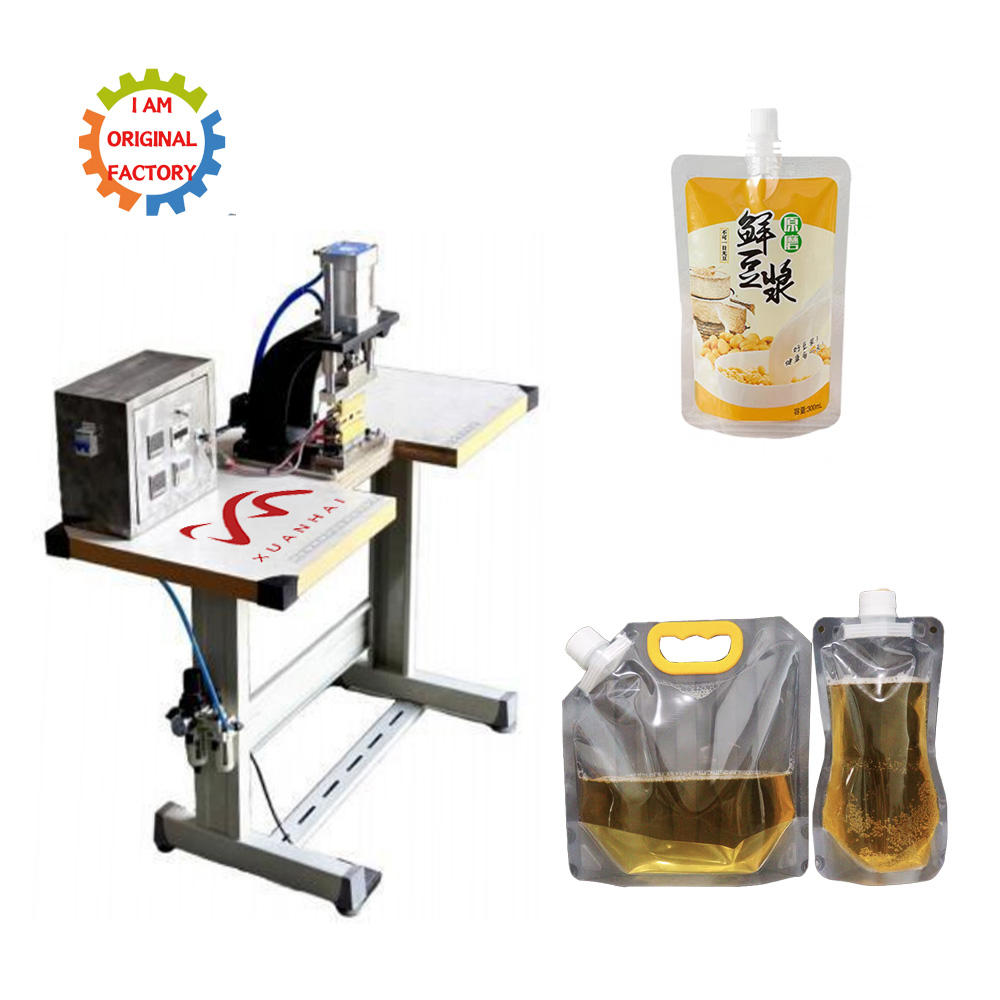
Manual Spout Inserting & Sealing Machine | Doypack, Juice, Detergent Pouch
Description
🏭 Industrial Packaging Equipment
Automatic Spout Inserting Machine for Flexible Pouches
Servo-driven, fully automatic spout insertion and heat sealing — built for stand-up pouches, doypacks, gusseted bags, and custom flexible packaging formats. CE certified. Export-ready.
Why Manufacturers Choose Our Spout Inserting Machines
120
Pouches per minute
max production speed
max production speed
±0.1°
Temperature accuracy
for consistent seals
for consistent seals
≤0.5
mm positioning tolerance
servo-precision alignment
servo-precision alignment
15+
Years of pouch machinery
engineering experience
engineering experience
What Is a Spout Inserting Machine?
A spout inserting machine (also called a spout sealing machine or spout fitment inserter) is specialized packaging equipment that automatically inserts a plastic spout fitment — the nozzle through which liquid is dispensed — into a pre-made flexible pouch and heat-seals it to create a leak-proof, airtight bond. The result is a spouted pouch ready for filling with juice, sauce, detergent, baby food, oil, lotion, or any flowable product.
Unlike rigid bottle filling lines, spout inserting machines are specifically engineered for the unique geometry of flexible pouches — accommodating the film's movement, maintaining precise spout alignment, and delivering a controlled, repeatable heat-seal every cycle.
Industry Note: Spout inserting machines are typically the first step in a complete spouted pouch line. After insertion and sealing, pouches move downstream to a spout pouch filling and capping machine for product filling and closure.
How a Spout Inserting Machine Works — Step by Step
Our machines operate on a fully automatic servo-controlled cycle. No manual positioning required. Here is the complete sequence:
STEP 01
Pouch Loading & Transport
Pre-made flat or stand-up pouches are loaded onto the conveyor belt feed system, which transports them to the pouch pick position automatically.
STEP 02
Pouch Gripping & Positioning
The gripper mechanism securely holds each pouch and transfers it to the precision positioning platform. Servo motors ensure ≤ 0.5 mm alignment accuracy.
STEP 03
Corner Cutting (if applicable)
For corner-spout configurations, the cutting station creates a precise notch in the pouch corner before spout insertion — ensuring a clean, flush fit.
STEP 04
Pouch Opening
Vacuum suction cups gently separate the two film layers at the insertion point, creating the opening needed for the spout fitment to be inserted cleanly.
STEP 05
Spout Insertion
The spout delivery system — fed by a vibratory bowl feeder — pushes the spout fitment into the opened pouch at the correct depth and angle. Rotation is applied where needed.
STEP 06
Pre-Heat & Heat Sealing
1 pre-heating station + 4 heat-sealing stations apply controlled temperature and pressure to fuse the spout flange to the pouch film. Accuracy: ± 0.1 °C, 0–300 °C range.
STEP 07
Cooling
A dedicated cooling station solidifies the seal immediately after heat application, locking in bond integrity and preventing deformation or seal relaxation.
STEP 08
Discharge & Inline Inspection
Finished spouted pouches are discharged via output conveyor. Optional vision inspection and reject systems verify seal quality before pouches enter the filling line.
Full Technical Specifications
All specifications below apply to our standard automatic linear-mode spout inserting machine. Custom configurations are available on request.
| Parameter | Details | Value / Range |
|---|---|---|
| Overall Dimensions | L × W × H | 2400 × 2200 × 2000 mm |
| Machine Weight | Approximate | 2100 kg |
| Working Speed | Standard / High-Speed | 60–120 pcs/min |
| Positioning Accuracy | Servo-controlled | ≤ 0.5 mm |
| Pouch Bag Length | L × W | 80–190 mm × 70–120 mm |
| Sealing Length | Heat-seal zone | 60–120 mm |
| Compatible Spout Sizes | Diameter (standard) | 8.5 / 10 / 14 / 16 mm (custom available) |
| Sealing Stations | 1 Pre-heat + 4 Heat-seal + 1 Cooling | 6 groups total |
| Temperature Control | Modules / Accuracy | 18 groups / ± 0.1 °C |
| Heating Range | Adjustable | 0–300 °C |
| Pouch Materials | Inner layer | PE, PP; Tubes: PE, PP |
| Pouch Types | Compatible formats | Stand-up, 3-side seal, gusseted, special-shaped |
| Power Supply | Electrical | 380V / 50Hz / 11 kW |
| Air Supply | Compressed air | 0.6–0.8 MPa / 2000 L/H |
| Certification | Safety & compliance | CE certified |
| Control System | PLC + HMI | Servo-driven, touchscreen interface |
Key Features & Technical Differentiators
What sets our spout inserting machines apart from standard market offerings:
Full Servo-Drive Architecture
Every motion axis — pouch transport, spout insertion, sealing press — is servo-controlled for micron-level repeatability and zero mechanical drift over time.
18-Zone Temperature Management
Individual PID control for each of 18 heating zones ensures uniform temperature across the sealing surface — eliminating cold spots and over-sealing simultaneously.
Quick-Change Tooling
Spout nests, gripper rails, and cutting dies can be swapped in under 15 minutes without special tools — minimizing downtime during SKU changeovers.
Integrated Seal Quality Detection
Optional inline vision system and leak-detection sensor automatically flags and diverts any pouch with a missing spout, misaligned fitment, or incomplete seal.
PLC + Touchscreen HMI
Store up to 50 product recipes. One-touch changeover. Real-time production data dashboard. Remote diagnostics port for after-sales support without site visits.
Seamless Line Integration
Designed with standardized interface protocols to connect directly to upstream pouch-making machines and downstream spout filling, capping, and labeling lines.
Application Industries & Product Types
Our automatic spout inserting machines serve a wide range of industries. Below are the most common applications by sector:
Beverages
Juice, smoothies, sports drinks, tea, water, functional drinks, alcoholic beverages
Baby Food
Purees, fruit pouches, yoghurt blends, fortified drinks — hygienic grade sealing
Sauces & Condiments
Ketchup, mayonnaise, hot sauce, salad dressing, cooking oil, marinade
Personal Care
Shampoo, conditioner, body wash, lotion, liquid soap, skin serums
Household Chemicals
Laundry detergent, dishwashing liquid, fabric softener, surface cleaners
Industrial & Agricultural
Lubricants, adhesives, fertilizer solutions, agrochemicals, automotive fluids
Manual vs. Semi-Auto vs. Fully Automatic: Which Spout Inserting Machine Is Right?
Understanding the differences helps you specify the correct machine for your production volume, budget, and quality requirements:
| Criteria | Manual | Semi-Automatic | Fully Automatic |
|---|---|---|---|
| Speed (pcs/min) | 5–15 | 20–40 | 60–120+ |
| Labor Required | 3–5 operators | 1–2 operators | 1 supervisor |
| Seal Consistency | Variable | Good | Excellent (servo) |
| Suitable for 24/7 runs | No | Partial | Yes |
| ROI Payback Period | Low capex, high opex | Medium capex | 12–24 months typical |
| CE Certification | Rarely | Sometimes | Standard (our models) |
| Multi-spout size support | Manual swap only | Limited | Quick-change tooling |
Spout Inserting Machine — Buyer FAQ
Questions we hear from packaging engineers and procurement teams every day:
What is the difference between a spout inserting machine and a spout filling machine?
A spout inserting machine inserts the plastic spout fitment into an empty pouch and heat-seals it — producing a "spouted blank" pouch with no product inside. A spout filling machine receives that spouted blank, fills it with liquid through the open spout, then caps it. They are two distinct machines, often combined in one integrated packaging line. We supply both, as well as complete integrated lines.
What pouch materials are compatible?
Our machines work with the most common flexible packaging laminates: PE/PET, PE/NY/PE, EVOH barrier films, CPP/PET, and AL foil structures. The key requirement is that the inner layer (in contact with the spout flange) must be PE or PP for reliable heat-sealing. We recommend sending us your actual pouch samples before finalizing tooling, to confirm seal parameter compatibility.
Can the machine handle both top-center spouts and corner spouts?
Yes. Our standard model handles corner spouts (the most common format for laundry detergent and liquid food pouches). Top-center spout configuration is available as an option or on dedicated models. Tooling changeover between corner and top-spout configurations is achievable with a mechanical tooling swap. Contact us to discuss your specific spout position requirement.
What spout diameters does the machine support?
Standard tooling supports 8.5 mm, 10 mm, 14 mm, and 16 mm diameter spouts — covering the vast majority of market-standard fitments (Bericap, Aptar, Guala, and equivalent). Custom spout diameters outside this range can be accommodated with purpose-made tooling sets. Lead time for custom tooling is typically 4–6 weeks.
What is the typical lead time and how are machines shipped?
Standard lead time is 45–75 days from order confirmation and deposit, depending on machine configuration and current production schedule. Machines are exported in wooden crates via ocean freight (FCL) or air freight for urgent orders. We provide complete export documentation: packing list, commercial invoice, certificate of origin, and CE declaration of conformity. Factory acceptance testing (FAT) is conducted before shipment — you are welcome to attend or we can provide video FAT.
What after-sales support do you provide?
We provide 12 months warranty on all mechanical and electrical components (excluding consumable wear parts). Support channels include: remote diagnostics via the machine's built-in communication port, video call support within 4 hours of request, and on-site service available in most countries with advance scheduling. We maintain a spare parts inventory for all current production models and provide a commissioning spare parts kit with every machine shipped.